Charles V became King of France in 1364, succeeding his father John II. He inherited a kingdom weakened by the defeats at Crécy and Poitiers, the captivity and ransom of his father, political unrest and the territorial concessions made at Brétigny.
Charles transformed French fortunes during the Hundred Years War. Rather than seeking the large set-piece battles that had brought disaster to his predecessors, he relied on experienced commanders, fortified positions and sustained pressure on English-held territories. By the end of his reign, France had recovered much of the territory lost earlier in the war.
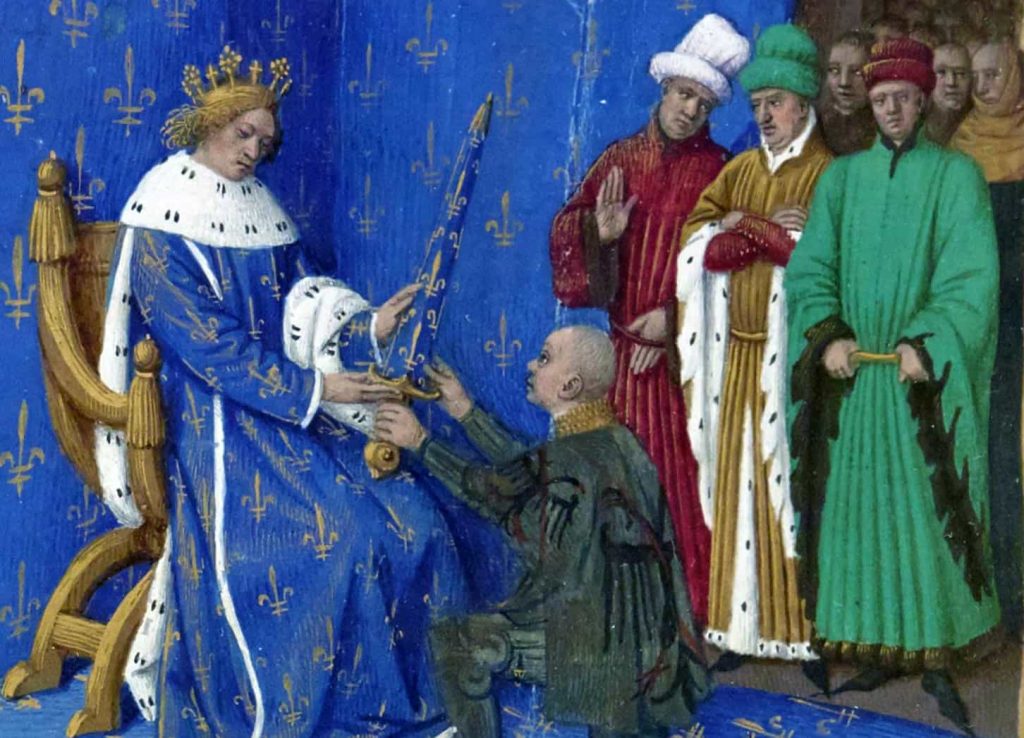
Charles V and the Hundred Years War
Accession and the Valois Monarchy
Charles had already gained experience of government as Dauphin during his father’s captivity. His accession therefore followed years of political and military crisis, but also gave the French monarchy a ruler experienced in administration and finance.
His coronation at Reims in 1364 presented the monarchy as restored after the disasters of the previous generation.
Charles V and Charles II of Navarre
Charles inherited the continuing problem of Charles II of Navarre. The French victory at Cocherel in 1364 strengthened the position of the Valois monarchy and demonstrated the importance of Bertrand du Guesclin to Charles V’s military policy.
- Charles II of Navarre
- Battle of Cocherel, 16th May 1364
- Reconciliation of Charles the Bad and the Dauphin, 1359
The Recovery of France
Charles V’s military policy was based on avoiding unnecessary major battles and using fortified towns, garrisons and experienced commanders to wear down English-held territories. Bertrand du Guesclin became the most important military commander associated with this strategy.
The approach contrasted sharply with the major English victories of Crécy and Poitiers and allowed the French gradually to recover territory without risking another catastrophic defeat.
The Renewal of War in 1369
The settlement created at Brétigny did not provide a lasting peace. Disputes over the interpretation and implementation of the treaty, combined with appeals from Gascon nobles against the government of the Black Prince, provided Charles with the opportunity to resume the war.
In 1369 Charles summoned Edward the Black Prince to answer before the Parlement of Paris and subsequently declared the English territories confiscated. War resumed and the French began a sustained campaign to recover their lost territories.
Bertrand du Guesclin and the French Counter-Offensive
Charles V relied heavily on Bertrand du Guesclin and other experienced captains to recover English-held territory. Du Guesclin became Constable of France in 1370 and played a central role in the campaigns of the 1370s.
The French strategy gradually reduced English control in Aquitaine and other parts of France while English attempts to relieve their garrisons increasingly became difficult and expensive.
Castile and the Wider War
Charles also intervened in the Castilian Civil War, supporting Henry of Trastámara against Peter of Castile. Bertrand du Guesclin led French forces into Castile, while the English intervention led by the Black Prince helped restore Peter temporarily.
The conflict demonstrated the international nature of the Hundred Years War and diverted English military resources away from the war in France.
Brittany
Charles V also attempted to strengthen French authority in Brittany. His intervention after the War of Breton Succession brought him into conflict with Duke John IV and contributed to the renewed involvement of England in Breton affairs.
Naval Warfare and the War at Sea
Naval power remained important during Charles V’s reign. French naval forces supported operations against English territory and helped to threaten English communications with Gascony.
The renewed importance of naval warfare during the Caroline phase of the conflict forms part of the wider development covered by the site’s Naval Warfare hub.
Charles V’s Government and Legacy
Charles V’s success depended not only on military commanders but on the financial and administrative capacity of the French monarchy. His reign strengthened royal government and provided the resources needed to sustain a prolonged war.
His death in 1380 left France in a much stronger position than the kingdom he had inherited. His son Charles VI succeeded him as a child, beginning a very different phase of Valois government.
Charles V’s Place in the Hundred Years War
Charles V transformed the course of the Hundred Years War. By combining stronger royal government with cautious military strategy, he reversed much of the territorial loss suffered under Philip VI and John II and established the French monarchy as the dominant power in the later fourteenth-century conflict.
Further Reading
- Françoise Autrand, Charles V le Sage (Fayard, 1994).
- Richard Vernier, The Flower of Chivalry: Bertrand Du Guesclin and the Hundred Years War (Boydell Press, 2003).
- Jean-Patrice Boudet, “Le modèle du roi sage aux XIIIe et XIVe siècles : Salomon, Alphonse X et Charles V”, Revue historique, 3/2008, no. 647, 545–566.
- Chris Given-Wilson, “Edward, the Black Prince, and Bertrand du Guesclin, Constable of France: Chivalry and Rivalry in Life and Death” (2022).