John II became King of France in 1350, succeeding his father Philip VI. His reign was dominated by the continuing war with England, political tensions within France and the financial pressures created by prolonged warfare.
John is particularly associated with the Battle of Poitiers in 1356, where he was captured by the English. His captivity contributed to a major political and financial crisis in France, while the Treaty of Brétigny established the terms for his release.
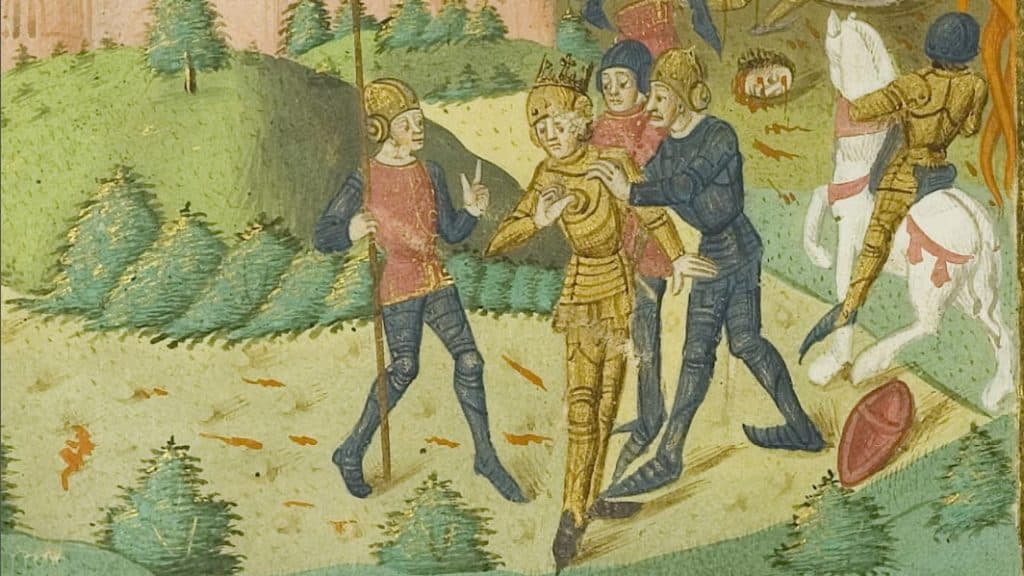
Chantilly, Bibliothèque et archives du château, 873 (501), f. 201v – vue 2 – Bataille de Poitiers
John II and the Hundred Years War
The Valois Monarchy
John inherited the French crown at a time when the Valois monarchy was under severe military and financial pressure. His reign provides an important link between the defeats of Philip VI and the French recovery under his son Charles V.
Charles II of Navarre
Charles II of Navarre was one of the most important political opponents of John II. His territorial interests and rivalry with the Valois monarchy became increasingly entangled with the wider war.
The assassination of Charles de la Cerda in 1354 intensified the rivalry, while the following year John attempted to manage the threat through negotiation and military preparations.
- Charles II of Navarre
- Charles de la Cerda
- French issue Ban and Arrière-Ban, May 1355
- Reconciliation of Charles the Bad and the Dauphin, 1359
Poitiers and the Capture of John II
The English campaign of 1356 culminated in the Battle of Poitiers. The French defeat and capture of John II created a major crisis for the French monarchy and left the Dauphin Charles responsible for government.
Government and the Estates-General
John’s captivity intensified disputes over taxation, royal authority and the government of France. The Estates-General of 1357 became an important focus for these political tensions.
The Jacquerie and Political Crisis
The political instability following Poitiers coincided with the Jacquerie of 1358 and continuing conflict in and around Paris. The revolt formed part of the wider crisis facing the French monarchy during John’s captivity.
The Treaty of Brétigny
The Treaty of Brétigny of 1360 provided for John’s release in return for a substantial ransom and major territorial concessions to Edward III. The financial arrangements proved difficult to fulfil and were subsequently revised; John ratified an update to the Treaty of Brétigny in 1363.
John II and Charles V
John returned to English captivity in 1364 after his son Louis of Anjou escaped from parole. He died in England that year and was succeeded by Charles V, whose reign saw a significant French recovery.
John II’s Place in the Hundred Years War
John II’s reign was a turning point in the first phase of the Hundred Years War. Poitiers, his captivity, the political crisis in France and the settlement at Brétigny all shaped the circumstances inherited by Charles V.
Further Reading
- Neil Murphy, The Captivity of John II, 1356–60: The Royal Image in Later Medieval England and France, The New Middle Ages (Palgrave Macmillan, 2016).
- Barbara Bombi, “From the Battle of Poitiers to the Treaty of Brétigny-Calais: Administrative and Diplomatic Practice in England and at the Papal Curia”, in Anglo-Papal Relations in the Early Fourteenth Century: A Study in Medieval Diplomacy (2019), 205–224.
- Justine Firnhaber-Baker, “The Social Constituency of the Jacquerie Revolt of 1358”, Speculum, 95.3 (2020), 689–715.
- John Le Patourel, “The Treaty of Brétigny, 1360”, Transactions of the Royal Historical Society, 10 (1960), 19–39.