Domestic politics played an important role in shaping the course of the Hundred Years War. In England, France and the other territories involved in the conflict, questions of royal authority, succession, finance, Parliament, faction and rebellion could influence how the war was fought and how its costs were borne.
These political developments were often closely connected to the war, but were not simply diplomatic aspects of the conflict. This page focuses on domestic politics during the Hundred Years War, with links to more detailed articles where they are available.

Domestic Politics and the War
England
English kings depended upon the support of nobles, councils and Parliament to finance the war and maintain political authority. Political disputes within England could directly affect the prosecution of the war in France.
Kingship, Authority and Legitimacy
Questions about the authority and legitimacy of the English monarchy were an important part of domestic politics during the Hundred Years War. The replacement of Edward II by Edward III and the later overthrow of Richard II illustrate the tensions that could arise when the exercise of royal authority was challenged.
- Edward III’s accession at the expense of his father, Edward II.
- The abdication of Edward II.
- The overthrow of Richard II by Henry Bolingbroke in 1399.
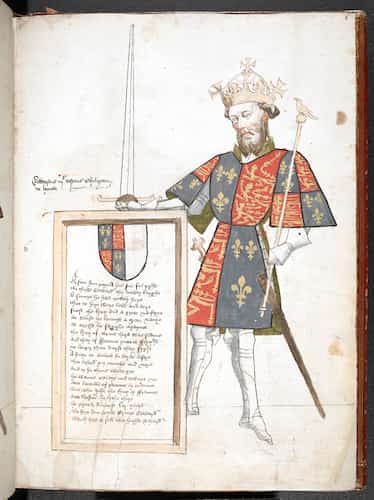
Royal Government and Finance
- How Edward III financed the conflict with France in its initial stages.
- The Great Crown of England used as security for a loan.
- Edward III’s second crown returned after being pawned.
Parliament and Political Intervention
- The Good Parliament of 1376 and its challenge to royal government.
- The Lords Appellant and the political crisis of 1386–88.
- The Merciless Parliament of 1388 and the removal of royal favourites.
- Richard II’s recovery of political authority from 1389 and the changing balance between king, nobles and Parliament.
Richard II and Political Upheaval
- The Peasants’ Revolt of 1381 and its political consequences.
- The political crisis of 1397–99 and the collapse of Richard II’s authority.
- The overthrow of Richard II by Henry Bolingbroke in 1399.
Henry IV
- The political challenges to Henry IV’s legitimacy after the Lancastrian seizure of power.
- Rebellions against Henry IV and the importance of Parliament, taxation and royal finance.
- The continuing political significance of the deposition of Richard II and the question of legitimate kingship.
Henry V
- Henry V’s accession and the consolidation of royal authority.
- The political justification for Henry V’s invasion of France in 1415.
- Parliamentary and political support for the later campaigns in France, including the financial demands created by the war.
- Henry V’s triumphant return to London in 1421 and the political significance of the Treaty of Troyes.
Henry VI and the Politics of Defeat

- Bedford, Gloucester and the competing interests within the government of the young Henry VI.
- Henry VI’s assumption of personal rule in 1437.
- The political consequences of military failure and the loss of English territory in France.
- The impeachment of William de la Pole, Duke of Suffolk.
Other English Political Developments
- The Bishop of Norwich’s Crusade of 1383.
- William Sawtrey and the political and religious context of heresy in 1401.
- Thomas of Lancaster’s appointment as Admiral of the King’s Fleet.
- The petition to Henry VI from Dutch merchants.
- The origins of the War of Saint-Sardos and its political context.
France
French politics were equally important to the course of the war. The strength or weakness of the Valois monarchy, disputes within the royal family and rival factions at court repeatedly affected the French war effort.
- Philip VI and the establishment of the Valois dynasty.
- Charles V and the strengthening of royal government.
- Charles VI and the crisis of royal authority.
- The rivalry between the Armagnacs and Burgundians, including the role of John the Fearless and the Burgundian faction.
- The murder of Louis, Duke of Orléans, and its political consequences.
- The Dauphin and the political crisis surrounding the Treaty of Troyes, including the influence of Yolande of Aragon.
- Charles VII and the recovery of French royal authority.
Burgundy and the Low Countries
The political position of Burgundy changed significantly during the later stages of the Hundred Years War. Burgundian rulers pursued their own territorial and dynastic interests, while the growing power of the duchy gave its rulers an important role in the political struggles within France and in the wider conflict with England.
- The growth of Burgundian power and the political influence of its dukes.
- John the Fearless and the struggle for political influence in France, including his conflict with the Duke of Orléans and the Armagnac faction.
- The murder of John the Fearless and its political consequences.
- Philip the Good and the changing relationship between Burgundy, England and France.
- The Burgundian decision to reach an agreement with Charles VII in 1435.
Other Political Powers
The war also involved political powers whose interests extended beyond the immediate conflict between the English and French crowns.
- Brittany and its changing alliances.
- Navarre and the ambitions of its rulers.
- Castile and the wider political struggle in the Iberian Peninsula.
- Scotland and its alliance with France.
- Flanders and the political importance of trade and economic interests.
Politics changed the character of the Hundred Years War. Dynastic claims, parliamentary intervention, factional struggles and changes in political allegiance could be as important to the course of the conflict as military victories and defeats. By the final years of the war, the loss of English territory in France was increasingly intertwined with political instability within England itself.
Further Reading
- David Green, The Hundred Years War: A People’s History (Yale University Press, 2014).
- Anne Curry, France in the Later Middle Ages 1200–1500, chapter 4, “France and the Hundred Years War, 1337–1453”.
- Graeme Small, “French Politics during the Hundred Years War”, in The Hundred Years War Revisited (Bloomsbury, 2019).
- David Grummitt, Henry VI (Routledge, 2015).
- G.L. Harriss (ed.), Henry V: The Practice of Kingship (Oxford University Press, 1985).