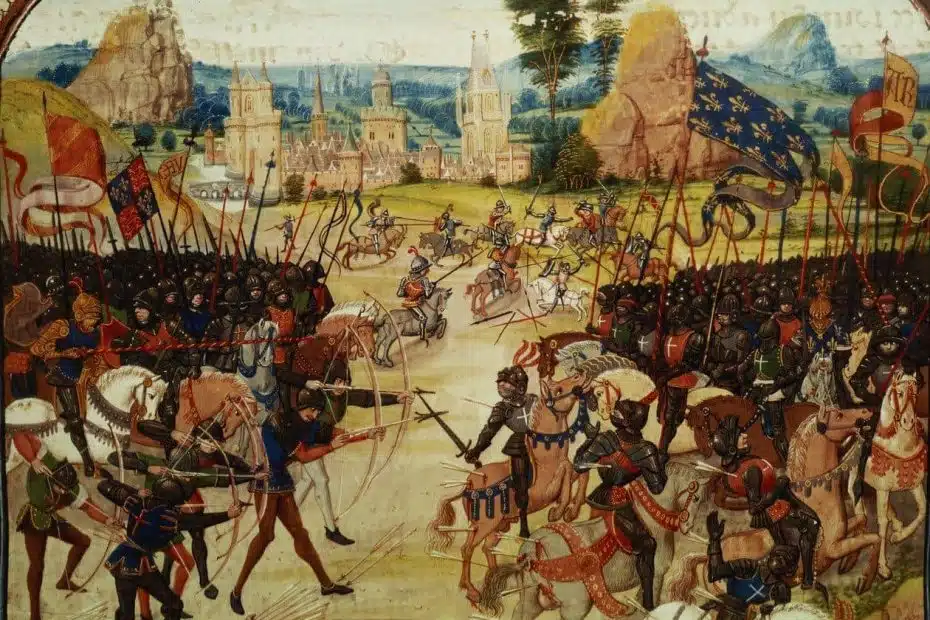
The Battle of Poitiers was fought on 19 September 1356. It saw an English army under the command of Edward of Woodstock, The Black Prince, engage a larger force commanded by King John II of France. Soldiers from Gascony were incorporated in the English force, whilst the French had the support of some allies, including 200 Scottish men-at-arms. This battle was a resounding victory for the English. The Black Prince’s force suffered minimal losses whilst the King of France himself was captured, with thousands more of his force being captured or killed.
Context
In 1355 Edward of Woodstock arrived in Gascony, having been appointed by his father, the King, as Lieutenant. Accompanied to Gascony by over 2000 English and Welsh men, he set about bolstering his force with retinues from Gascon nobles. In the Autumn of 1355 he led this army on a chevauchee out of Gascony and into the deep south of France. It devastated large parts of the French countryside and terrorised many towns. Having sacked Narbonne and ransacked the town, but not fortress, of Carcasonne, he returned to Bordeaux in December of 1355.
The French had been unable to stop the chevauchee. Forces took time to muster, and the speed at which the English and Gascons moved was such that it had proved impossible to determine exactly when, or where, to array men to any effect. In 1356, the same chaos of English and Gascon raiders appearing without warning was again put to good effect. This time, Edward of Woodstock chose to raid further north, capturing and retaining a large number of small fortifications to the north of Gascony. From here, the force continued to raid deep into French territory.
To compound the problems faced by King John II, he had faced civil unrest and a rebellious Charles II of Navarre in Normandy. So too did he face the English there, as Henry of Grosmont was diverted from a planned campaign in Brittany to take advantage of the turmoil in Normandy.
With Charles II of Navarre captured and the chevauchee of Henry of Grosmont over, John II was able to turn his attention to the marauding force of Edward of Woodstock to the south of Normandy.
Build up to the Battle
Having moved north of the River Loire, the Anglo-Gascon force had been hoping to merge with that of Henry of Grosmont. By September, this was highly unlikely. The French were aware of this. The King’s force in Normandy effectively blocked any route by which the two English commanders could join by land. Now the French believed they could turn the tide of war in their favour. The Dauphin moved south, entering Tours with an estimated thousand men-at-arms on 12 September. On the same day, Edward of Woodstock’s force had encamped at Montbazon. The two armies were just 11 miles apart.
Aware of the likelihood of a battle, the Cardinal of Périgord entered into discussion with both parties. This made Edward of Woodstock increasingly alert to the risk that his men faced. Any agreed delay for negotiations or for an arranged battle would leave his force short of supplies and in a vulnerable geographical position. So, the Anglo-Gascon force moved south. It was shadowed by the French, now including the King and the main body of the Royal army.

On 17 September a seemingly unarmoured French force of 700 men-at-arms was routed. As a result, King John II drew his army together near Poitiers, where they were placed into battle formations. Again, the Cardinal of Périgord, Hélie de Talleyrand-Périgord, attempted to negotiate a truce.
Whilst those negotiations had some success, there were pressures on both commanders to engage in battle rather than accept an alternative. And so, on 19 September 1356 the Battle of Poitiers was fought.
Battle of Poitiers
The battle is well documented. Several chroniclers were at the battle. Others heard of it from eyewitnesses. This gives us a range of contemporary accounts that inform our understanding of how the battle was fought. What is clear is that this was a battle in which a wide range of technologies was used. The Longbow is synonymous with English armies of the age, and it is no surprise that crossbows were used in large numbers. The most detailed of the contemporary accounts of the battle is the one penned by Geoffrey le Baker, who notes other weapons and some tactics more usually associated with earlier periods:
“The trumpets sounded and clarions, warhorns and drums replied. Until the sounds echoed along the Poitevin woods, until the hills seemed to roar to the valleys and the clouds of thunder. Nor did these thunders lack thunderbolts. For the light sparkled golden on the armour, and the flying spears cascaded from polished shields, their points finding their mark like thunderbolts. Then the threatening mob of crossbowmen darkened the sky with a dense mist of bolts, and the archers replied with a hail of arrows from the English side, who were now in a state of desperate fury. Ashwood javelins flew through the air to greet the enemy at a distance, and the dense troops of the French army protecting their bodies with joined shields, turned their faces away from the missiles…”
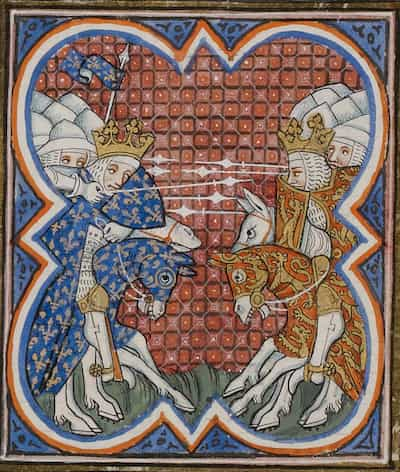
Tactically, the English performed incredibly well. A false retreat is mentioned in several accounts. So too is an outflanking move, enabling the rear of the French lines to be attacked. The outcome was an overwhelming English victory. Froissart describes it:
“And as it was reported, there was slain all the flower of France, and there was taken with the king and the lord Philip his son a seventeen earls, beside barons, knights and squires, and slain a five or six thousand of one and other”.
Consequences of the Battle of Poitiers
The English victory was as stunning and complete as perhaps it was unexpected. King John II was a captive, as were other nobles. Furthermore, a large number of French men-at-arms had perished in the Battle of Poitiers. Political instability that had presented the French Crown with issues prior to the campaigns of 1355 and 1356 reappeared. There was little option but to seek a truce whilst negotiating for the release via ransom of their King. Nor was there the leadership, or stomach, for an immediate return to active hostilities. France needed time to recover, allowing England time to consolidate her position.
Further reading – Books
- Peter Hoskins, In the Steps of the Black Prince: The Road to Poitiers, 1355–1356 (Boydell Press, 2011). Particularly useful for the campaign route and the chevauchée leading to Poitiers.
- David Green, The Battle of Poitiers 1356 (History Press, 2008). A dedicated study covering the 1355 campaign, preparations, 1356 campaign, battle and aftermath, using contemporary sources.
- Jonathan Sumption, The Hundred Years War, Vol. II: Trial by Fire (Faber & Faber, 1999). A broader scholarly account, with a substantial section specifically on Poitiers 1356.
Further reading – Articles
“The Itineraries of the Black Prince’s Chevauchées of 1355 and 1356: Observations and Interpretations” — Journal of Medieval Military History.
Clifford J. Rogers, “The Battle of Poitiers, 1356” — Desperta Ferro, No. 38 (2016). A dedicated scholarly treatment of the battle.