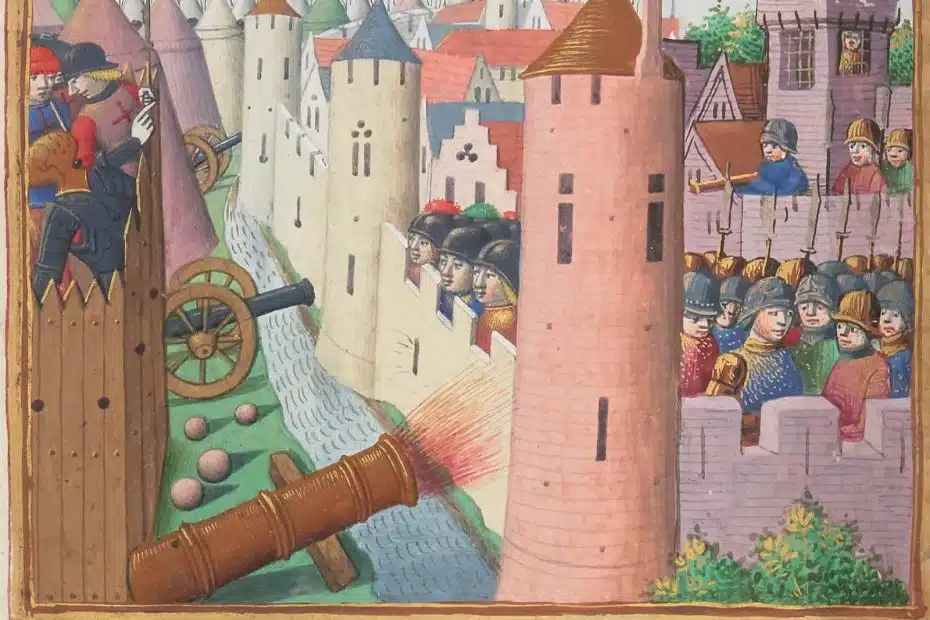
The Siege of Orléans was fought between October 1428 and May 1429. An English army under the Earl of Salisbury and, after his death, the Earl of Suffolk attempted to capture the strategically important city on the Loire. The siege placed pressure on the government of Charles VII and threatened one of the principal strongholds of the French position in central France.
The defenders resisted a sustained English siege while French commanders attempted to organise relief. The defeat of a French and Scottish force carrying out a sortie against an English supply convoy at the Battle of the Herrings in February 1429 demonstrated the difficulty of relieving the city. The arrival of Joan of Arc with a French relief force in late April changed the situation. A series of attacks on the English positions followed, and the English abandoned the siege on 8 May 1429.
The Siege of Orléans, 1428–1429
The English Approach
The English army reached Orléans in October 1428. The city was one of the most important French strongholds on the Loire and had strong political connections with the imprisoned Duke of Orléans. Its capture would have extended English control south of the Loire and placed further pressure on the government of Charles VII.
The defenders had prepared for the siege. The suburbs outside the walls were demolished so that the English could not use the buildings as cover or establish fortified positions close to the city. Enguerrand de Monstrelet, writing from the Burgundian side of the conflict, described the preparations made by the defenders and the early English operations.
“the garrison and inhabitants had long expected his arrival, and had provided themselves with all sorts of warlike stores and provision”
The English established fortified positions around the city and began a prolonged siege. Monstrelet later stated that the English had constructed more than sixty batteries and towers. Other accounts give lower figures, reflecting differences in what was counted as a fortified position.
“they had much straitened it by their batteries and towers, of which they had erected not less than sixty.”
The surviving accounts also show that the siege was not a simple blockade. There were repeated sorties, exchanges of artillery fire and fighting around the English fortifications. The defenders retained enough freedom of movement to make sorties and, at least during parts of the siege, to obtain supplies.

The Death of the Earl of Salisbury
The English siege was initially commanded by Thomas Montagu, Earl of Salisbury. Soon after the English established themselves before Orléans, Salisbury was examining the city from one of the positions on the bridge when a French artillery shot struck him.
Monstrelet described the weapon as a veuglaire. The shot struck Salisbury in the face and killed another man standing behind him. Salisbury survived for several days before dying from his wounds.
“a stone from a veuglaire struck the window”
The death of Salisbury did not end the siege. Command passed to William de la Pole, Earl of Suffolk, while the English continued to strengthen their positions around the city.
The Defences of Orléans
The defenders included French troops, local militia and commanders with considerable experience of the war. Among the captains associated with the defence were Jean, Bastard of Orléans, Raoul de Gaucourt, Poton de Xaintrailles and La Hire.
The city also possessed substantial artillery. The surviving municipal and fortress accounts are valuable because they record expenditure, supplies, fortifications and military equipment rather than presenting the siege as a sequence of heroic episodes.
The edition of the Journal du siège d’Orléans published in 1896 includes extracts from the accounts of the royal treasurer Hémon Raguier, the accounts of the city of Orléans and a fortress account covering the period from March 1429 into 1431. These records provide evidence for the practical administration of the defence.
The English Bombardment
Artillery played an important role throughout the siege. The surviving siege journal records the damage caused by English bombardment, including the use of exceptionally heavy stone shot.
“fired stones that weighed 824 pounds and did much ill and damage to the city and many houses and fine buildings thereof”.
The artillery evidence is important because the siege was not simply a contest between English archers and French defenders. Guns were used by both sides, and the accounts provide evidence for the purchase, movement and use of artillery and other military stores.
English administrative records also survive for the army before Orléans. Louis Jarry’s edition of Le compte de l’armée anglaise au siège d’Orléans, 1429 brought together the surviving material relating to the English army’s finances and organisation during the siege.
The Battle of the Herrings
By February 1429 the defenders were under increasing pressure as the English siege restricted the movement of supplies into Orléans. An English convoy carrying provisions and military supplies was attacked near Rouvray on 12 February by a French and Scottish force commanded by the Count of Clermont and Sir John Stewart of Darnley.
The English successfully defended the convoy, and the defeat was a serious setback for the relief effort. The Battle of the Herrings is examined separately, including the English and French accounts of the fighting and the role of the Scottish troops.
The failure of the relief attempt meant that the defenders remained dependent upon the resources available within Orléans. The siege continued.
Joan of Arc Reaches Orléans
Joan of Arc reached the French court at Chinon in March 1429. Charles VII subsequently authorised her to accompany a relief expedition carrying supplies to Orléans.
Jean Chartier, the royal chronicler of Charles VII, describes the decision to send Joan with the relief force. His account presents the expedition as part of the king’s response to the situation at Orléans.
“the king in his council avised that icelle Pucelle irait ravitailler la cité”
The relief force assembled at Blois and travelled towards Orléans with supplies. Joan entered the city on 29 April 1429.
Chartier records that the English abandoned the bastille of Saint-Jean-le-Blanc as the relief force approached and withdrew towards the Augustins. The French force was able to bring supplies into the city.
“A leur arrivée les Anglais abandonnèrent une de leurs bastilles, celle de Saint Jean-le-Blanc”
The Burgundian chronicler Jean de Wavrin gives an independent account of the situation inside the city. His account describes the pressure created by the English siege works and the arrival of reinforcements and supplies.
“very strongly pressed by the diligence of the besiegers, both by their engines and by the towers which they had made around the town”
Wavrin gives a figure of twenty-two towers, considerably lower than Monstrelet’s figure of more than sixty. The difference illustrates the difficulties involved in interpreting the chroniclers’ numbers. The figures may reflect different methods of counting the English fortifications rather than a simple contradiction.
The French Attacks
The arrival of the relief force did not immediately end the siege. Fighting intensified during the first week of May. French and English forces contested the English fortifications around the city, while supplies were brought into Orléans.
The surviving siege journal records the fighting on a day-by-day basis and is especially useful for the sequence of sorties and assaults. Its surviving form, however, requires caution. The oldest surviving copy is later than the siege, and from 8 May onwards the text ceases to function as a continuous diary and incorporates material from other sources.
Jean Chartier also describes the fighting. His account records the abandonment of English positions and the French attacks on the remaining bastilles.
Other French accounts give additional details, while the English chronicles are much briefer. The contrast is striking. Gregory records the breaking of the siege in only a few words, while the French narratives devote considerably more space to the sequence of attacks.
The Assaults on the English Positions
The first major attacks were directed against the English fortifications outside the city. Saint-Loup was attacked and captured, followed by further attacks against English positions.
The fighting culminated in the assault on the English position at the bridge and the Tourelles. The English garrison resisted, but the position was eventually captured by the French.
The accounts differ in their emphasis. French narratives present the attacks as a sequence of successful assaults, while administrative records provide evidence of the supplies, equipment and payments required to sustain the operation. The combination of these sources gives a fuller picture of the campaign than any single chronicle.
The English Abandon the Siege
By 7 May the English position had become increasingly difficult to maintain. Their fortified positions around Orléans had been attacked and captured, while the French had established a secure presence inside and around the city.
The English commanders decided to withdraw. On 8 May the English army assembled and left its remaining positions.
Monstrelet describes the withdrawal after the destruction of the English forts:
“they abandoned their forts, setting fire to several”
The English army did not attempt a final battle outside the city. The siege had failed, and the remaining forces withdrew towards territories still controlled by the English and their allies.
News of the Victory
The importance of Orléans was understood outside France as well as by the armies immediately involved. A contemporary letter from Bruges provides an indication of the significance attached to the siege by observers in the wider European trading world.
On 10 May 1429, the Italian merchant Pancrazio Giustiniani wrote to his father in Venice. His information was not based on personal observation, but the letter shows how the siege was understood outside the immediate French and English theatres of war.
“if the English were to take Orléans, they would easily make themselves lords of France, and Charles would be reduced to begging for his bread.”
The letter was written only two days after the English withdrawal. It provides contemporary evidence that the outcome was regarded as politically significant beyond the immediate military result.
The English Accounts of the Siege
The English chroniclers provide a useful counterweight to the French accounts. Their treatment of the siege is much shorter. Gregory’s Chronicle records the breaking of the siege but gives the credit to “the Pusylle” and other French forces. Other London chronicles attribute the victory to the Duke of Alençon and his forces.
The brevity of the English accounts is useful evidence. They record the failure of the siege without reproducing the detailed sequence of events found in the French narratives.
Some English chronicles also contain errors. Several incorrectly state that Suffolk, Talbot and Scales were captured at Orléans. They were not. Such mistakes demonstrate why individual chronicle accounts need to be compared rather than treated in isolation.
The Significance of the Siege
The lifting of the siege transformed the military situation in central France. The French had retained Orléans, while the English army had lost its positions around the city and withdrawn.
The French army then moved rapidly against English-held positions along the Loire. Jargeau, Meung and Beaugency followed, culminating in the Battle of Patay on 18 June 1429.
The sequence from Orléans to Patay was a connected military campaign rather than a series of isolated victories. The recovery of the initiative around the Loire allowed Charles VII’s forces to move into areas that had previously been dominated by the English.
The victory also had a political dimension. Charles VII was subsequently able to advance towards Reims, where he was crowned in July 1429. The reign of Charles VII entered a new phase after the events of the Loire campaign.
The Siege of Orléans was therefore one of the major battles and sieges of the Hundred Years War, but its significance can be understood only by placing the fighting within the wider military campaign of 1428–1429.
Sources and Evidence
The evidence for the Siege of Orléans is varied. There are local administrative records, English financial and military records, French royal chronicles, Burgundian accounts and contemporary correspondence from outside France. These sources do not always agree on numbers or on the interpretation of events.
The Journal du siège d’Orléans is particularly valuable for the sequence of fighting, but its surviving textual form is later than the siege. The oldest surviving copy is dated 1472, and the text after 8 May incorporates material from other sources. It should therefore be used alongside the contemporary administrative records rather than treated as an untouched eyewitness diary.
The chronicles of Jean Chartier, Enguerrand de Monstrelet and Jean de Wavrin provide different perspectives. Chartier wrote within the royal French tradition; Monstrelet was a Burgundian chronicler; Wavrin had strong connections with the English and Burgundian military world. The English chronicles are much briefer, but provide an important comparison with the French narratives.
| Source | Origin and character | Evidence for the siege |
|---|---|---|
| Journal du siège d’Orléans, 1428–1429 View source |
Orléans; siege journal preserved in a later manuscript tradition | Daily sequence of the siege, sorties, assaults, English fortifications and the arrival of Joan. The surviving text needs to be distinguished from the original contemporary journal or register. |
| Jean Chartier, Chronique de Charles VII View source |
French royal chronicle; near-contemporary | Joan’s arrival, the relief expedition, abandonment of Saint-Jean-le-Blanc and the subsequent fighting. |
| Enguerrand de Monstrelet, Chroniques View source |
Burgundian chronicle; near-contemporary | English siege works, Salisbury’s death, the Battle of the Herrings, Joan’s arrival, the attacks on the English positions and the withdrawal. |
| Jean de Wavrin, Chroniques View source |
Burgundian chronicler with strong English connections | Pressure on the defenders, English siege works, reinforcements and supplies brought towards Orléans. |
| Perceval de Cagny, Chroniques View source |
Angevin/French; near-contemporary chronicle associated with the house of Alençon | Campaign narrative and evidence for the French military operations of 1429. The surviving text is known through a later copy. |
| Gregory’s Chronicle View source |
English/London chronicle | Brief English account of the Battle of the Herrings and the breaking of the siege in May 1429. |
| Chronicles of London and Brut continuations View source |
English chronicles | Very brief accounts of the breaking of the siege, including attribution of the victory to the Duke of Alençon in some versions. Some copies contain erroneous claims about English prisoners. |
| Orléans municipal and fortress accounts View source |
Contemporary French administrative records | Expenditure, supplies, fortifications, payments and the practical organisation of the defence. |
| Le compte de l’armée anglaise au siège d’Orléans, 1429 View source |
English military and administrative records | Evidence for the organisation and finances of the English army during the siege. |
| Antonio Morosini, Chronique View source |
Italian/Venetian source tradition | Includes contemporary reports circulated in Italy about the importance of Orléans and the rapid rise of Joan’s reputation. |
| Pancrazio Giustiniani’s letter, 10 May 1429 View source |
Italian merchant in Bruges; contemporary correspondence | Contemporary evidence for the importance attached to the outcome of the siege outside the immediate French and English theatres. |
| Chronique de la Pucelle View source |
French later compilation preserving earlier material | Contains detailed narratives of the relief of Orléans and the fighting, but the surviving compilation was made after the events and should not be treated as a contemporary chronicle. |
The sources agree on the broad course of the siege: the English established a substantial fortified position around Orléans; the defenders endured a prolonged siege; the February relief attempt failed; a new French relief force reached the city in late April; the English positions were then attacked in early May; and the English abandoned the siege on 8 May.
They differ over numbers, the size and identity of particular forces, the number of English fortifications and the precise role played by individual commanders. The English chronicles are also markedly less detailed about the final week of the siege than the French sources. The administrative records provide an important check on the narrative accounts because they record the material costs and organisation of the defence.
Further Reading
- Philippe Contamine, “Observations sur le siège d’Orléans (1428–1429)”, in Les enceintes urbaines (XIIIe–XVIe siècle), Éditions du CTHS, 2004, pp. 332–343.
- Olivier Bouzy, “Le siège d’Orléans a bien eu lieu ou le Dasein de Jeanne d’Arc dans la guerre de Cent Ans”, Connaissance de Jeanne d’Arc, no. 31, 2002, pp. 49–62.
- Adalbert de Beaucorps, “La reconstitution du fort des Tourelles”, Bulletin de la Société archéologique et historique de l’Orléanais, XVI, no. 204, 1913, pp. 401–405.
- Edmond Desnoyers, “Les armes du siège de 1428”, Mémoires de la Société archéologique et historique de l’Orléanais, XVIII, 1884, pp. 449–452.