Henry VI became King of England in 1422 following the death of his father, Henry V. Under the Treaty of Troyes of 1420, Henry V had been recognised as heir to Charles VI of France, and Henry VI inherited the claim to both kingdoms. His accession therefore came at a critical moment in the Hundred Years War.
Henry was an infant, and government was therefore placed in the hands of a minority council. His uncle John, Duke of Bedford, became Regent in France and was responsible for maintaining the English position there, while Humphrey, Duke of Gloucester played a leading role in government in England. The central challenge was to defend Henry’s inheritance in France as French resistance recovered.
Henry VI and the Hundred Years War
Accession and the Dual Monarchy
Henry became king as an infant in 1422, following the deaths of Henry V and Charles VI of France. Under the Treaty of Troyes, Henry inherited the English claim to the French crown. In practice, however, his authority was contested by the Dauphin Charles and his supporters.
The Minority Council
Because Henry was an infant, England was governed by a minority council. His uncle John, Duke of Bedford, became the principal English commander and Regent in France, while Humphrey, Duke of Gloucester played a leading role in government in England. Maintaining the English position in France was the central strategic problem facing the minority government.
England and Burgundy
The English position depended heavily upon its alliance with Burgundy. The Treaty of Amiens in 1423 strengthened the alliance between England, Burgundy and Brittany and recognised Henry VI’s claim to the French crown. The relationship with Burgundy was central to English power in France, but it eventually broke down as French diplomacy changed the balance of power.
French Resistance and Joan of Arc
English forces initially retained extensive territories in northern France, but resistance from supporters of the Dauphin continued. The English defeat at Montargis in 1427 demonstrated that English armies could be beaten. The emergence of La Hire and, above all, Joan of Arc transformed French morale and military momentum. The relief of Orléans and subsequent French victories forced the English into retreat.
Henry VI’s Coronation as King of France
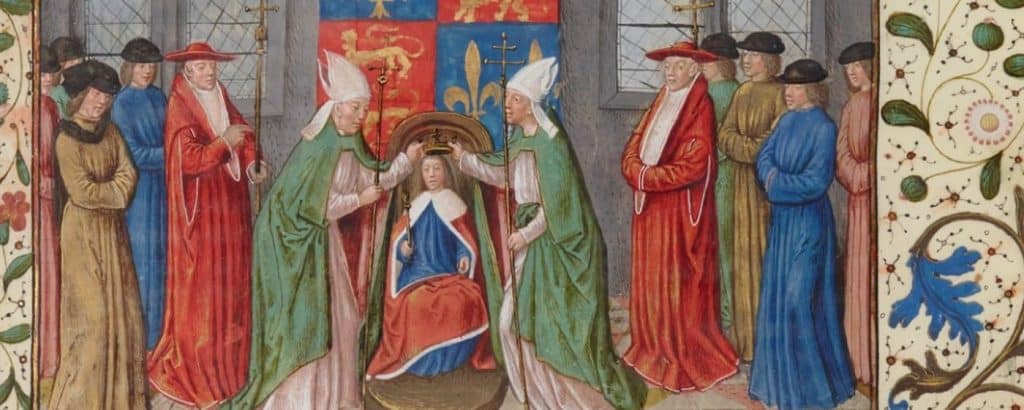
Henry was crowned King of England at Westminster in 1429 and King of France at Notre-Dame in Paris in 1431. The French coronation was intended to reinforce the claim created by the Treaty of Troyes, but the coronation of Charles VII at Reims and the continuing French recovery undermined the English position.
The Loss of Paris and Burgundy’s Change of Allegiance
The English position deteriorated rapidly during the 1430s. Paris was recovered by the French in 1436, while the death of John, Duke of Bedford in 1435 removed one of the most important figures in the English administration of France. Burgundy subsequently abandoned its alliance with England and reached an agreement with Charles VII, leaving the English increasingly isolated.
Henry VI and Margaret of Anjou
Diplomacy increasingly replaced military success as England struggled to maintain its French territories. The Treaty of Tours in 1444 brought a truce with France and arranged Henry’s marriage to Margaret of Anjou. The agreement also involved the cession of English territories in Maine, provoking criticism in England and contributing to disputes over the conduct of the war.
- Impeachment of William de la Pole, Duke of Suffolk
- Date by which Le Mans was to be handed to the French
William de la Pole and the Failure of English Policy
William de la Pole, Duke of Suffolk, became one of the most influential figures in Henry VI’s government. He played a leading role in diplomacy with France and negotiated the Treaty of Tours and Henry’s marriage to Margaret of Anjou. His association with the loss of English territory and the failures of the war made him increasingly unpopular, culminating in his impeachment and exile in 1450.
The Fall of Normandy
The truce failed to provide a lasting settlement. French military power recovered and the English position in Normandy collapsed in 1449–1450. The loss of Normandy was followed by the fall of further territories, leaving Calais as the principal English possession in France.
Henry VI, Calais and Richard Duke of York
The loss of Normandy intensified criticism of Henry VI’s government. Richard, Duke of York, had served as Lieutenant of France and became increasingly associated with opposition to the policies of the royal court. Calais remained strategically and economically important, but the deterioration of England’s position in France became a major source of political tension at home.
The End of the Hundred Years War
By 1453 England had lost Normandy and Gascony, while the French victory at Castillon brought the major phase of the Hundred Years War to an end. Calais remained in English hands, but Henry VI’s claim to the French crown had become largely theoretical. The failure of the war contributed to political instability in England and formed an important background to the Wars of the Roses.
Henry VI and the Wars of the Roses
Henry VI’s failure to maintain England’s position in France was closely connected to the political crises of his later reign. His periods of illness, disputes between rival councillors and the growing rivalry between the Lancastrian court and Richard, Duke of York, eventually led to armed conflict. The First Battle of St Albans in 1455 marked the beginning of the Wars of the Roses as a sustained conflict between rival political factions.
Further Reading
- Anne Curry, The Hundred Years War, 1337–1453 (2012).
- David Grummitt, The Calais Garrison: War and Military Service in England, 1436–1558, new edition (2026).
- Michael Hicks, Richard, duke of York, and the crisis of Henry VI’s household in 1450–1: some further evidence, Journal of Medieval History, 38.2 (2012).
- Christine Carpenter, Henry VI and the Deskilling of the Royal Bureaucracy (2010).