The Battle of Baugé was fought on 22 March 1421 between an English army under Thomas, Duke of Clarence, and a Franco-Scottish force supporting the Dauphin Charles. Scottish troops formed an important part of the victorious army, which also included French and other allies.
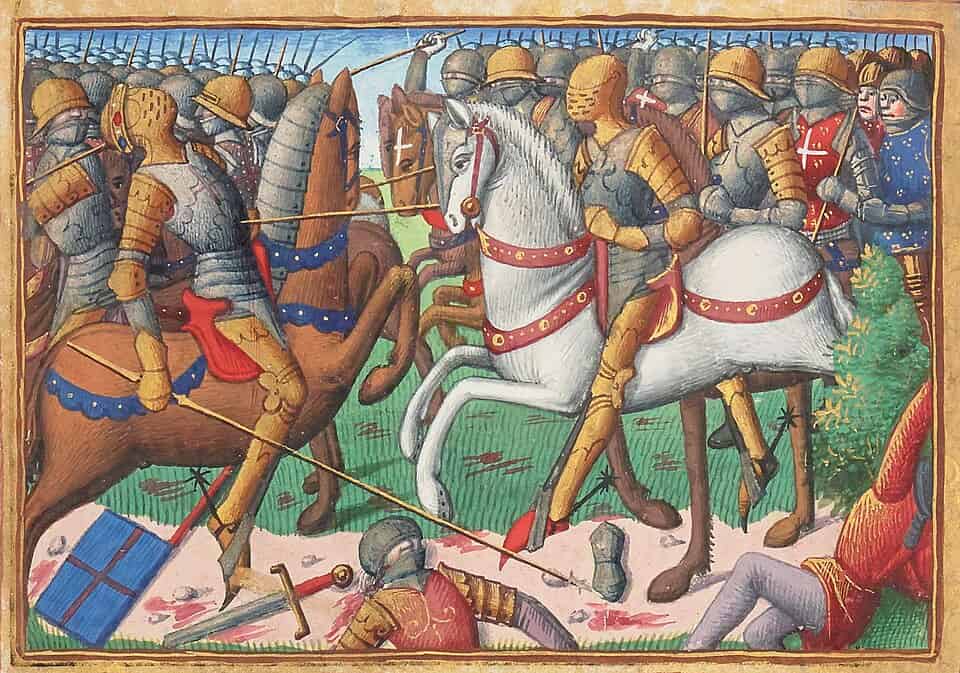
The Battle of Baugé, 1421
Henry V Returns to England
Henry V had returned to England in February 1421, leaving his eldest brother, Thomas Duke of Clarence, as commander of the English forces in France.
The instructions that the king left for his brother were to engage in a chevauchée against the Franco-Scottish force in Maine and Anjou.
The Franco-Scottish Army
Franco-Scottish forces were located throughout the area into which Clarence’s chevauchée was operating. One such force was gathered near Baugé in Anjou. The Scottish contingent included the Earl of Douglas and other Scottish lords, while the French forces included men serving the Dauphin. Prisoners taken by the English are said to have revealed the whereabouts of this force. Some sources, see links below, suggest that the initial scouting of the group near Baugé revealed 400 of the Franco-Scots to the English: with others said to be in woods, unsighted by the scouts.
A letter sent by the Scottish lords to the Dauphin on the night of the battle provides an unusually close contemporary account. They reported that they had arrived at Baugé on the Friday intending to give battle, but had planned to wait until the following Monday because Easter Sunday was considered too important a feast for fighting. The English arrived before that planned engagement could take place.
Clarence Learns of the Dauphin’s Army
Clarence had a sizeable force at his disposal. The English forces, however, were dispersed in separate encampments.
When Clarence learned of the presence of the Dauphin’s army, he chose to attack rather than wait for his whole force to assemble. The reasons for this are not known which leads to suggestions of rashness, though it could have been based upon scouting reports which underestimated the size of the enemy.
The English Advance
The decision to attack quickly deprived Clarence of the advantage provided by his larger army. Equally, it prevented the Earl of Douglas and his army from fully preparing for the battle which they intended to offer after Easter Sunday. The English advance, in some sources, was toward a host of some 400 men. Letters sent by the Scottish nobles state that the English appeared before Baugé in battle formation about an hour before sunset. The Scottish lords then went against them and claimed that the field was won for the Dauphin. Elsewhere, it is noted that the Franco-Scottish forces who had not been sighted by the English were able to respond to the unexpected English advance.
The Battle of Baugé
The battle developed into a defeat for the English. The Duke of Clarence, Earl of Tankerville and Baron Ros were killed, while the Duke of Exeter, Earl of Somerset, Earl of Huntingdon and Baron Fitzwalter were taken prisoner.
The contemporary Scottish letter reported the death of Clarence and the Earl of Kent, together with the capture of Huntingdon and Somerset. It also claimed that the flower of the English force had either been killed or captured.
Later French and Scottish chronicles provide differing accounts of the precise course of the fighting. The Journal d’un bourgeois de Paris, for example, describes Clarence inspecting the battlefield before the engagement and records the English being attacked from several directions after entering a wooded area. It also describes the destruction of a bridge and the escape of only a small proportion of the English force.
English sources, outlined below, hint at this being the case. There remains no eyewitness account of the engagement though, so the way in which the battle was fought and developed is based on administrative records and letters which celebrate victory rather than a range of battlefield accounts.
The Death of Clarence
Thomas, Duke of Clarence, was killed at Baugé. His death was a major loss to the English command in France. The Scottish victory report sent to the Dauphin specifically identified Clarence’s death and stated that his banner had been captured.
The Scottish letter named Thomas Walen, a gentleman of the Earl of Douglas’s household, as the man who had captured the bearer of Clarence’s banner.
The identity of the man who killed Clarence is less certain. Scottish, French and later English traditions give different accounts, and the chronicles cannot be treated as providing a single uncontested version of the event.
Walsingham’s Account
The Chronicle of Thomas Walsingham describes the events from an English perspective. His account presents the defeat as the consequence of Clarence’s decision to engage the enemy before his full force had been assembled.
Other English and French narratives provide additional details and sometimes contradict one another. John Hardyng’s later chronicle, for example, places emphasis on advice given to Clarence to wait for the remainder of the army, while French accounts provide different descriptions of the fighting and the forces involved.
The Scottish Victory Report
The letter sent by the Scottish lords to the Dauphin was written at Baugé at midnight on the eve of Easter, immediately after the battle. It therefore provides an important contemporary account of the Scottish view of the victory.
The writers reported the deaths of Clarence and the Earl of Kent, the capture of Huntingdon and Somerset, and the death of Charles le Bouteiller, seneschal of Berry. They also urged the Dauphin to come to Anjou and proceed into Normandy, declaring that with God’s help everything was his.
The letter was not a neutral battlefield report. It was a victory communication intended for the Dauphin, and it also included a request concerning the vacant office of seneschal of Berry. Its value lies in its date and proximity to the battle, while its presentation of the scale of the victory reflects the interests of its authors.
The Consequences of Baugé
The defeat at Baugé removed Clarence from command and resulted in the capture of several senior English commanders. It also demonstrated the ability of the Franco-Scottish alliance to defeat an English force in the field. At the time, this was hugely important. After Agincourt, the French and their allies had faced a seemingly invincible English force in the battles and sieges of Henry V’s campaigns in Normandy and northern France. Now, they had renewed hope.
Baugé had presented the English with an opportunity to defeat the Dauphin and his supporters. The English had a substantially larger force available, but Clarence’s decision to attack before it had fully assembled ended in a major defeat and the death of the king’s brother.
Sources and Evidence
| Source | Key point |
|---|---|
| Scottish lords’ letter to the Dauphin, 22 March 1421 | Immediate Scottish victory report written at Baugé on the night of the battle. It records Clarence’s death, the capture of Huntingdon and Somerset, the capture of Clarence’s banner, and the death of Charles le Bouteiller. View source |
| Thomas Walsingham, Historia Anglicana | English chronicle account of the battle and Clarence’s death. View source |
| John Hardyng, Chronicle | Later English account that gives prominence to the failure to wait for the full English force and to advice given to Clarence before the battle. View source |
| Journal d’un bourgeois de Paris | Parisian account recording information that reached Paris shortly after the battle. It describes Clarence’s reconnaissance, the English advance and attacks from several directions, while its date for the battle is corrected by the editor to 22 March 1421. View source |
| Chronique de la Pucelle | French narrative identifying Clarence and a number of French and Scottish commanders and describing the defeat, deaths and prisoners. View source |
| Enguerrand de Monstrelet, Chronique | French/Burgundian narrative of the battle, including the defeat of the English and the recovery of Clarence’s body. View source |
| Walter Bower, Scotichronicon | Scottish account of Baugé and Clarence’s death, useful for comparison with other Scottish traditions. View source |
| Liber Pluscardensis | Scottish account preserving traditions about the battle and the death of Clarence, including details that differ from other narratives. View source |
| Perceval de Cagny, Chronique | French/Angevin narrative relevant to the military circumstances of the battle, including the absence of Clarence’s archers from the initial engagement. View source |
| Georges Chastellain, Chronique | Burgundian account providing another version of Clarence’s death and the battle. View source |
| Antonio Morosini, Chronique | Italian/Venetian evidence for the circulation of news about the battle beyond France and England. View source |
| Mémoriaux de la Chambre des comptes d’Anjou | Contains a contemporary Angevin relation of the battle, preserved among the records of the Chambre des comptes. View source |
| Jean Juvénal des Ursins, Histoire de Charles VI | Later French narrative providing another account of the campaign and battle. View source |
These accounts differ in their presentation of the battle, the size and deployment of the forces, and the circumstances of Clarence’s death. The Scottish letter is the closest contemporary evidence, while the chronicles provide later narrative traditions from English, Scottish, French, Burgundian and Italian perspectives.
Further Reading
- John D. Milner, “The Battle of Baugé, March 1421: Impact and Memory”, History 91:304 (2006), pp. 484–507.
- Anne Curry, Agincourt: A New History of the Battle and Its Context (2005).
- Michael Jones, “The Battle of Baugé and the Scottish Contribution to the War in France”, History Today.
- Matthew Strickland, Scotland and the English Wars, 1296–1568.