The Battle of La Rochelle was fought on 22 June 1372 during the renewed Anglo-French war. An English fleet commanded by John Hastings, Earl of Pembroke, was sent towards La Rochelle as French pressure on the English-held territories in Aquitaine and Saintonge increased. A Castilian fleet under Ambrosio Boccanegra had arrived to support the French war effort. The resulting naval battle ended in a major English defeat, with a substantial part of the English fleet destroyed or captured and Pembroke himself taken prisoner.
The battle changed the maritime balance of the Hundred Years War. It strengthened Franco-Castilian control of the waters around the French Atlantic coast and enabled further French and Castilian naval operations. It did not give France permanent control of the English Channel, and English armies continued to reach the continent.
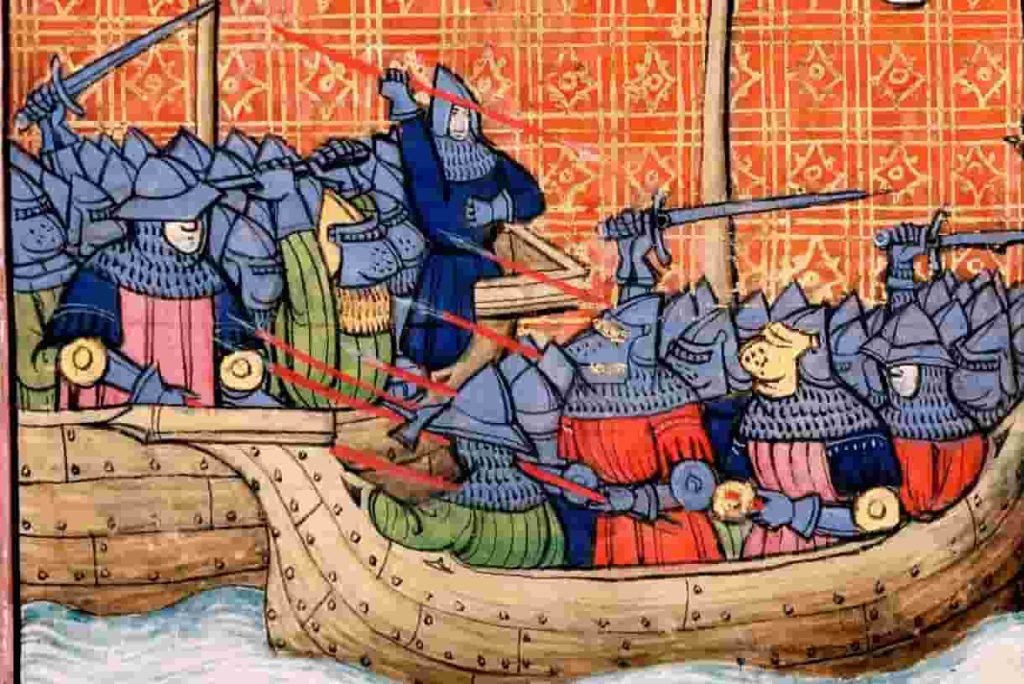

The Battle of La Rochelle, 1372
French and Castilian Pressure
By 1372 the position of the English in south-western France had deteriorated. Charles V had resumed the war against England in 1369, while the alliance between France and Castile gave the French access to an important naval ally. Castilian naval forces could operate alongside French forces in the Bay of Biscay and along the Atlantic coast, threatening English communications with Aquitaine.
La Rochelle was a major port and an important point of communication for the English territories in south-western France. Control of its approaches affected the movement of troops, supplies and shipping between England and Aquitaine. English ports on the continent were an important part of the wider system supporting English campaigning.
The campaign of 1372 involved French, Castilian and Welsh forces. The naval battle and the subsequent land operations around La Rochelle formed separate stages of the wider campaign.
Owen of Wales
Owen of Wales was serving Charles V when the campaign of 1372 began. He had command of a force operating against the English and had conducted an expedition against Guernsey, including the siege of Château Cornet. Charles V subsequently directed Owen towards the Castilian alliance as part of the preparations for further operations against the English.
Owen was involved in the wider La Rochelle campaign, but arrived too late to take part in the naval battle itself. The Castilian fleet which defeated the English under the Earl of Pembroke was already operating in the area before Owen arrived with the subsequent force.
Owen subsequently participated in the campaign around La Rochelle. At Soubise he captured the Captal de Buch and Sir Thomas Percy. His role belongs to the operations that followed the naval battle rather than to the engagement between Boccanegra’s fleet and Pembroke’s expedition.
The English Relief Fleet
The English response was the dispatch of a fleet under John Hastings, Earl of Pembroke. Its purpose was to relieve the English position at La Rochelle and restore the ability of English forces to operate in the region. The expedition had both a military and logistical purpose, since control of the sea was essential for the movement of troops, supplies and communications between England and Aquitaine.
The English force was not a fleet of purpose-built warships. Fourteenth-century English naval warfare depended heavily upon merchant and transport shipping, supplemented by vessels capable of fighting at sea. J. W. Sherborne’s research demonstrates the importance of shipping resources and manpower to the English naval effort during the later fourteenth century. The wider subject is covered by the site’s Naval Warfare hub.
The exact size and composition of Pembroke’s fleet remain uncertain. The surviving accounts give different figures for the number of English vessels and for the Castilian fleet. Some accounts distinguish between galleys, larger ships, barges and transport vessels, while others use broader terms.
The Battle
When Pembroke’s fleet approached La Rochelle, it encountered the Castilian fleet commanded by Ambrosio Boccanegra. The two forces engaged in the waters outside the port.
Froissart is among the principal narrative sources for the battle. His account provides information about the forces involved and the course of the fighting, although the figures and details vary between accounts. French and Castilian sources provide additional perspectives on the engagement.
The battle took place in waters where tides, depth and the ability of different types of vessels to manoeuvre affected the fighting. The conditions around La Rochelle favoured vessels capable of operating effectively in shallow water.
The Tide and the Shallows
The changing tide was important to the course of the battle. Castilian galleys were well suited to operating in relatively shallow water, while the larger English vessels were more vulnerable when movement became restricted.
As the battle developed, English vessels became increasingly vulnerable in the shallows. Ships that could not manoeuvre freely were exposed to attack, and vessels could be boarded or set alight. The physical environment of the battlefield formed part of the Castilian victory.
The English Defeat
The result was a major defeat for the English expedition. A substantial number of English vessels were destroyed or captured, while many of the soldiers and sailors carried by the fleet were killed or taken prisoner. John Hastings, Earl of Pembroke, was among those captured.
The precise number of casualties and prisoners is uncertain. Contemporary and near-contemporary accounts provide different figures, while later estimates have sometimes been considerably higher. Froissart gives different figures in different versions of his chronicle, while Castilian and French sources provide other numbers. Totals are therefore estimates.
The capture of Pembroke had consequences beyond the battle. His captivity removed an important English commander and created financial and political complications. Accounts of his subsequent ransom can be compared with the documentary evidence.
The Fall of La Rochelle
The naval defeat did not itself capture La Rochelle. The city’s subsequent submission formed part of the wider French campaign in the region. French and allied forces continued to apply pressure on the English-held territories, while the political position of the city changed during the campaign.
Owen of Wales participated in these subsequent operations. His arrival after the naval battle places his activities within the continuing campaign rather than the naval engagement itself. His capture of the Captal de Buch and Thomas Percy at Soubise formed part of the military pressure on the English position.
The eventual submission of La Rochelle resulted from the wider campaign involving the naval defeat, subsequent land operations and political change.
Froissart and the Battle
Froissart provides one of the principal narrative accounts of the events surrounding La Rochelle. His Chroniques contain information about the forces involved and the course of the campaign, while the surviving manuscripts were produced over a considerable period after the events.
Dirk Schoenaers examines the illustrated manuscripts of Book Three of Froissart’s Chroniques, including the Arundel and Besançon manuscripts in which the La Rochelle episode is illustrated. The Arundel miniature probably represents the first assault by land under the Earl of Arundel, while the Besançon manuscript concentrates on the subsequent naval battle. Both illustrations belong to later manuscript traditions and represent the events through the visual interpretation of Froissart’s narrative rather than through contemporary observation of the battle.
The French Narrative Evidence
The Grandes Chroniques de France provide a French narrative perspective on the campaign. Their account helps place the naval defeat within the wider sequence of operations around La Rochelle, including the subsequent French and allied activity.
The Chronique de Bertrand du Guesclin, associated with the poet Cuvelier, is another narrative source for the campaign. It provides evidence for the activities of French and allied forces, including Owen of Wales. Its chronology can be compared with Froissart and the French chronicles when reconstructing the sequence of operations.
The different narrative traditions provide varying accounts of the numbers involved, the course of the battle and the subsequent campaign. Taken together with documentary evidence, they establish the broad sequence while leaving some details uncertain.
The Naval Consequences
La Rochelle changed the maritime situation in the western theatre of the war. The Franco-Castilian alliance had already provided France with a powerful naval resource, and the defeat of the English fleet gave the French greater security along their Atlantic coastline.
French naval preparations expanded during the following years. Merchant vessels were requisitioned for military use, while the Clos des Galées at Rouen produced a substantial number of new warships in 1376 and 1377. French naval organisation was also strengthened under Jean de Vienne. By 1377 Franco-Castilian forces were capable of launching raids against the English coast.
These developments did not produce permanent French command of the Channel. The French could operate more freely along their Atlantic coastline, while English armies continued to cross to the continent and English-held ports remained important bases for subsequent operations.
The earlier Battle of Sluys had given England a very different maritime position in 1340, when the French fleet was defeated and English control of the Channel was strengthened.
La Rochelle and the Wider War at Sea
The significance of La Rochelle formed part of a wider transformation in the naval war. The battle exposed the vulnerability of English transport and naval forces when operating in waters controlled by an increasingly effective Franco-Castilian alliance.
J. W. Sherborne’s study of the English navy demonstrates the importance of shipping and manpower to the English war effort, while his detailed study of La Rochelle places the battle within the naval operations of 1372–75.
The wider military context was also changing. English forces remained capable of mounting major expeditions after 1369, while French strategy increasingly relied upon attrition, siege warfare and attacks on communications rather than repeated large-scale pitched battles. La Rochelle changed the maritime balance without ending English military activity in France.
After La Rochelle
The English continued to conduct military operations in France after the defeat. The following years saw further attempts to maintain English positions in south-western France and to use fleets to support military operations.
The French and Castilian naval effort also continued. The enlarged naval capacity that developed after La Rochelle enabled further operations against English shipping and coastal settlements, including Franco-Castilian raids on the English coast in the later 1370s.
The battle formed part of a broader process rather than constituting a single turning point in the whole war. Its importance was greatest in the western maritime theatre, where the defeat weakened the English ability to protect communications and strengthened the French position along the Atlantic coast.
Significance
The Battle of La Rochelle was one of the major naval engagements of the later fourteenth century. It destroyed or captured a substantial part of an English expeditionary fleet, resulted in the capture of the Earl of Pembroke and strengthened the position of the Franco-Castilian alliance.
Its wider importance lay in the maritime consequences. The victory helped the French secure their Atlantic coastline and provided the naval conditions for further operations against English shipping and coastal settlements. La Rochelle did not reproduce the strategic consequences of Sluys in 1340: France did not obtain total command of the seas, and English armies continued to reach the continent.
The battle was a major stage in the changing naval balance of the Hundred Years War after 1369 and formed part of the wider campaign that brought La Rochelle into the French sphere.
Sources and Evidence
The evidence for La Rochelle comes from several distinct traditions. Froissart provides an extensive narrative account, while the Grandes Chroniques de France and the Chronique de Bertrand du Guesclin provide French perspectives on the campaign. Castilian material supplies another perspective on the naval engagement and the fate of the English fleet.
The chronicles differ over the number and type of vessels involved, the precise course of the fighting and the number of prisoners. Froissart’s figures also vary between versions of the Chroniques. The broad outcome is consistent across the sources, while some numerical and chronological details remain uncertain.
Documentary evidence identifies individuals and events within the wider campaign. The evidence concerning Owen of Wales establishes his participation in the operations around La Rochelle while placing his arrival after the naval battle. His subsequent activities, including the capture of the Captal de Buch and Thomas Percy at Soubise, belong to the continuing campaign.
The illustrated Froissart manuscripts provide evidence for the later medieval representation of the campaign. The Arundel and Besançon manuscripts contain different visual treatments of the La Rochelle episode, with the Arundel miniature associated with the land assault and the Besançon miniature concentrating on the naval battle.
Modern scholarship approaches the battle from several directions. J. W. Sherborne’s detailed study remains the principal specialist study of the Battle of La Rochelle itself. His wider work examines English naval manpower and shipping. Gary Paul Baker places the battle within the changing English military strategy of the later fourteenth century, Taylor L. Lewis examines the development of French military and naval systems, and Dirk Schoenaers considers the transmission and illustration of Froissart’s account. These studies place La Rochelle within the wider naval and military developments of the period.
Further Reading
- J. W. Sherborne, “The Battle of La Rochelle and the War at Sea, 1372–5”, Bulletin of the Institute of Historical Research 42:105 (1969), pp. 17–29.
- J. W. Sherborne, “The English Navy: Shipping and Manpower, 1369–1389”, Past & Present 37:1 (1967), pp. 163–175.
- J. W. Sherborne, “The Cost of English Warfare with France in the Later Fourteenth Century”, Bulletin of the Institute of Historical Research 50:122 (1977), pp. 135–150.
- Gary Paul Baker, “The English Way of War, 1360–1399”, PhD thesis, University of Hull (2011).
- Dirk Schoenaers, “History of Conflict or Manual of Conduct? Continuity and Change in the Illustration and Interpretation of Book Three of Froissart’s Chroniques”, Queeste 18:2 (2011), pp. 93–149.
- Taylor L. Lewis, “The Evolution of Military Systems during the Hundred Years War”, GVSU McNair Scholars Journal 19:1 (2015), Article 14.
- Paulin Paris, ed., Les Grandes Chroniques de France, vol. 1 (Paris, 1836).