Charles VI became King of France in 1380, succeeding his father Charles V. His reign began during a period of French recovery but ended with France divided by civil war, English conquest and the disputed succession created by the Treaty of Troyes.
Charles VI’s reign included a long period of relative peace with England, renewed warfare under Henry V, the rise of the Armagnac and Burgundian factions and the king’s recurring periods of illness. The Hundred Years War entered a new and more dangerous phase during the final decades of his reign.
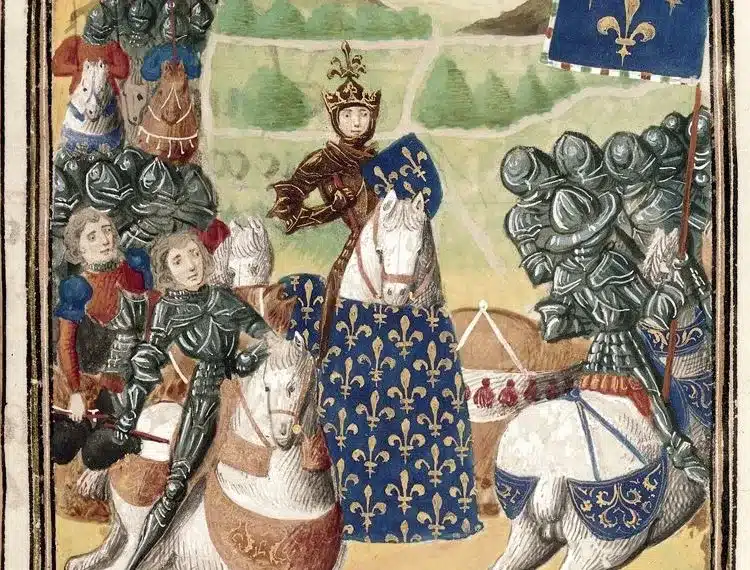
Charles VI and the Hundred Years War
Accession and the Valois Monarchy
Charles VI became king as a child and was initially governed by his uncles. His early reign continued the stronger position established by Charles V, including the recovery of much of the territory lost to England during the earlier phases of the war.
The balance changed as competing royal princes increasingly sought influence over government and the resources of the monarchy.
Peace with England and Richard II
Charles VI’s reign began with a period in which France and England moved towards a more durable peace. The Truce of Leulinghem was extended several times, while the marriage of Charles’s daughter Isabella to Richard II formed part of the diplomatic relationship between the two kingdoms.
Charles VI and Royal Government
Charles initially took a more active role in government, but his periods of illness increasingly affected the operation of the monarchy. His condition created opportunities for powerful relatives and factions to compete for control of government.
The resulting political instability became one of the defining features of the later reign.
Armagnacs and Burgundians
The rivalry between the Armagnac and Burgundian factions became increasingly important as Charles VI’s ability to govern fluctuated. The struggle centred on control of the king and the French government rather than simply on competing regional interests.
The assassination of Louis, Duke of Orléans, in 1407 intensified the conflict. John the Fearless and the Burgundian faction subsequently became major political forces within France.
Renewed War with England
The period of relative peace eventually ended. In 1404 the French government raised a major taille to finance renewed warfare against England, with plans that included operations against Gascony, Calais and support for opponents of Henry IV.
The renewed conflict coincided with political instability in England and helped establish the conditions inherited by Henry V.
Agincourt and the English Conquest
Henry V’s invasion of 1415 transformed the position of France. The French defeat at Agincourt was followed by the systematic English conquest of Normandy and growing pressure on the French monarchy.
The conflict was compounded by the continuing Armagnac-Burgundian civil war, leaving France divided when it most needed political unity.
The Treaty of Troyes
The murder of John the Fearless in 1419 pushed Burgundy into alliance with England. The resulting diplomatic settlement produced the Treaty of Troyes in 1420, under which Henry V was recognised as heir to Charles VI and married Charles’s daughter Catherine of Valois.
The treaty disinherited the Dauphin Charles and created the succession crisis that dominated French politics after Charles VI’s death.
Charles VI’s Death and Succession
Charles VI died in 1422, only weeks after the death of Henry V. The Treaty of Troyes meant that his death created competing claims to the French crown: the infant Henry VI was recognised by the English and their allies, while Charles VI’s son claimed the French crown as Charles VII.
The succession transformed the Hundred Years War into a struggle not only over territory but over the identity and legitimacy of the French monarchy.
Charles VI’s Place in the Hundred Years War
Charles VI’s reign marked the transition from the French recovery of Charles V to the crisis of the early fifteenth century. Periods of peace gave way to renewed English invasion, while royal illness and factional conflict weakened the ability of the French monarchy to respond.
By the time of Charles VI’s death, France was divided between competing political factions and rival claims to the crown, creating the circumstances in which the later phase of the Hundred Years War developed.
Further Reading
- Bernard Guenée, Un roi et son monde: Charles VI (Tallandier, 1992).
- Kristin Bourassa, “Using dedications to Charles VI to convey political messages: Honorat Bovet, Philippe de Mézières, Christine de Pizan and Pierre Salmon”, French History, 35.3 (2021), 291–308.
- Willy Morice, “L’opération Charles VI, un essai de prosopographie collective” (2011).
- Dominique Demartini et al., Charles VI ou les paradoxes d’un règne, Médiévales, no. 88 (2025).