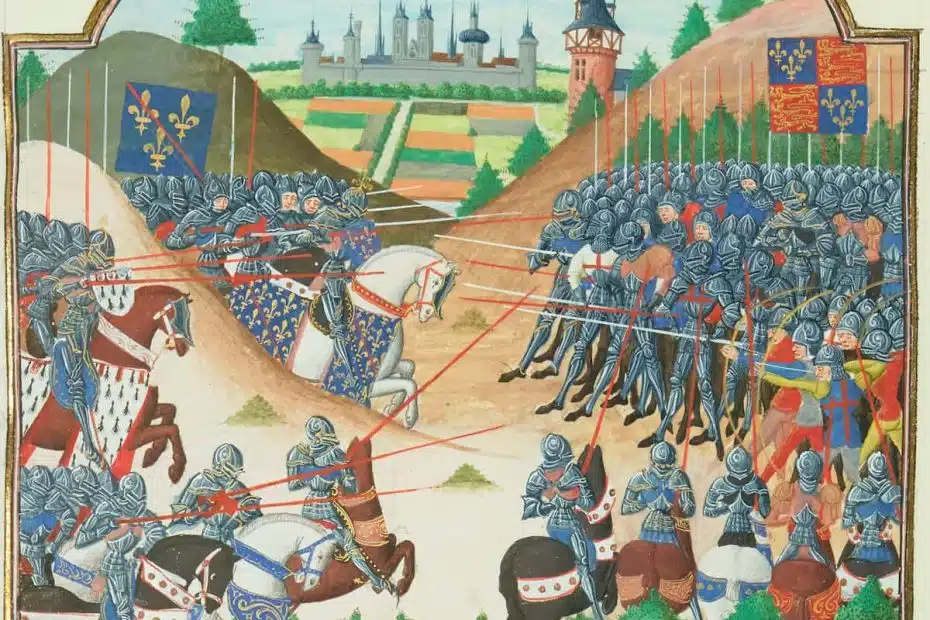
The Battle of Formigny was fought on 15 April 1450 between an English army under Sir Thomas Kyriell and a French army commanded by Jean, Count of Clermont. Breton forces under Arthur de Richemont, Constable of France, arrived during the battle and attacked the English position from another direction. The English army was defeated and Kyriell was captured.
Formigny was fought during the French reconquest of Normandy. The English army had landed at Cherbourg in March 1450 to reinforce the remaining English positions, while French forces were moving to recover the duchy. The battle destroyed the principal English field army in Normandy and was followed by the rapid recovery of much of the remaining English-held territory.
The Battle of Formigny, 1450
The English Reinforcement of Normandy
By the spring of 1450 the English position in Normandy was under severe pressure. French forces had recovered much of the duchy during the campaign of 1449, while English garrisons remained in a number of towns and fortresses.
Sir Thomas Kyriell landed at Cherbourg in March with an English force intended to reinforce the Duke of Somerset, the English governor of Normandy. Kyriell moved first against Valognes, which surrendered on 10 April, before continuing towards Bayeux.
The wider defence of Normandy was directed by Edmund Beaufort, Duke of Somerset. His position was becoming increasingly difficult as French forces advanced on several fronts and English garrisons needed reinforcement.
The English army that marched from Valognes was therefore not simply a field army seeking battle. Its immediate purpose was to reinforce the English position in Normandy and join Somerset’s forces.
Kyriell’s March to Bayeux
Kyriell’s force crossed the difficult country around the Vire and moved towards Bayeux. Matthew Gough, the English captain known to the French sources as Mathago or Matago, was also operating in the area.
The English reached Formigny on 14 April. The village lay between Isigny and Bayeux, close to the stream of the Val. The English established a defensive position using the terrain and began constructing field fortifications.
The account of the campaign preserved in Le recouvrement de Normendie describes the English preparing trenches before their position:
“the English made large holes and trenches with their daggers and swords before them”
The trenches were intended to hinder a French cavalry attack. The English also positioned themselves near the river and the gardens and hedges around the village, which provided further protection.
The French Army
Jean, Count of Clermont, commanded the French force pursuing the English. Clermont was still a young commander, and his army had been assembled at Carentan.
Arthur de Richemont, Constable of France and Duke of Brittany, was also moving towards the area with Breton troops. The French commanders therefore had two forces that could potentially combine against the English.
The timing of their arrival became critical. Clermont reached the English before Richemont’s main force had joined him. The French attack therefore began while the English still possessed a strong defensive position and numerical superiority according to several contemporary accounts.
The French Attack
The French began attacking the English position on the morning of 15 April. The fighting initially centred on the stream, bridge and crossings near the English position.
The French also employed artillery. Two culverins were brought forward and fired against the English position. The accounts differ over the immediate effect of the guns, but they were captured by the English during the fighting before being recovered by the French.
Jean Chartier’s account describes the English reaction to the approach of Richemont’s force as a withdrawal towards Caen and Bayeux:
“Incontinent que lesdits Anglois … apperceurent la venue d’iceluy connestable”
The account of Le recouvrement de Normendie gives a more prolonged sequence, describing several hours of skirmishing before the arrival of Richemont’s troops changed the situation.
Richemont Arrives
Richemont had been at Trévières and was moving towards the battlefield. The firing of the French artillery helped reveal the location of the fighting.
Prigent de Coëtivy, Admiral of France, was present with Clermont’s army. In a letter written shortly after the battle, he emphasised the importance of Richemont’s arrival. Writing to Pierre de Carné, he stated:
“je crois que Dieu nous y amena monsieur le Connestable”
Coëtivy went on to explain that without Richemont’s arrival, the French force might have suffered “dommaige irreparable”. His account is significant because he was a participant in the fighting and wrote shortly afterwards.
The letter also gives an important indication of the balance of forces. Coëtivy stated that the English were between five and six thousand strong and that they were roughly twice the size of the French force that had initially engaged them.
The English Position is Outflanked
Richemont’s arrival placed the English in a difficult position. They had chosen their defensive ground carefully, but the arrival of another French force threatened their flanks and their line of retreat.
The French and Breton forces attacked from different directions. Pierre de Brézé led an attack against an English fortified position, while French and Breton troops contested the bridge and crossings over the stream.
The English had initially been able to resist the attacks. Their defensive position and field works reduced the effectiveness of French cavalry attacks, while their archers added considerable missile fire.
The arrival of Richemont’s troops changed the tactical situation. The English could no longer concentrate their defence against Clermont alone.
The Battle
The fighting became a general engagement around the English position. French and Breton troops crossed the stream and attacked the English from more than one direction.
Le recouvrement de Normendie records that Clermont’s force attacked while Richemont’s troops crossed by a ford and a small stone bridge:
“they attacked the English on both sides very bravely”
The English position began to collapse. Matthew Gough and Robert Vere escaped from the battlefield, while Kyriell and a number of other English commanders were captured.
The surviving accounts differ considerably over the number of English killed. A French battlefield report gave 3,774 dead and between 1,200 and 1,400 prisoners. Guillaume Gruel, whose account is associated with Richemont and who is identified by later scholarship as an eyewitness, gives a substantially different total. An English administrative list later recorded 2,300 dead and 600 prisoners.
The differences make precise casualty figures impossible to establish. The sources do agree that the English army suffered extremely heavy losses and that a substantial number of its senior commanders were captured.

Kyriell is Captured
Sir Thomas Kyriell was among the English commanders captured during the battle. His capture was quickly reported in England.
A letter written by William Lomner to John Paston on 5 May 1450, only three weeks after the battle, reported:
“Sir Thomas Kiriel is take prisoner, and alle the legge harneyse, and abowte iij m Englishe men slayn.”
The letter also reported that Matthew Gough had escaped with approximately 1,500 men.
This English evidence provides an important comparison with the French chronicles. The writer did not have access to the detailed French battlefield narratives, but the news had reached England quickly enough for the capture of Kyriell and the scale of the defeat to be reported within weeks.
The Role of Artillery
Formigny is associated with the early use of field artillery in a major battle. The French employed two culverins during the engagement, and the contemporary accounts record their capture and recovery.
The sources do not support a simple claim that artillery alone decided the battle. The guns appear to have played a role in the opening fighting, while the arrival of Richemont and the attacks against the English flanks were central to the collapse of the English position.
The artillery may also have had an indirect effect. The sound of the guns helped alert Richemont that fighting had begun. The contemporary letter of Prigent de Coëtivy places particular emphasis on the timing of the Constable’s arrival rather than presenting the artillery as the sole cause of victory.
The Defeat of the English
Once the English position was attacked from several directions, their defensive formation broke. The hedges, gardens and enclosed ground that had helped protect the English during the battle also made their retreat more difficult.
Some Englishmen were captured by the French and Breton troops. Others escaped towards Bayeux and Caen. The contemporary accounts also describe killings during the pursuit, although the scale and circumstances of these losses vary between the sources.
Kyriell, Henry Norbury and other English commanders were captured. Matthew Gough and Robert Vere escaped.
The English Loss of Normandy
Formigny did not by itself remove the English from Normandy. Several major fortresses and towns remained in English hands, and the French still had to conduct a series of sieges and negotiated surrenders.
The battle did, however, remove the principal English field force available to oppose the French advance. Caen fell in June, followed by further English losses during the summer. Cherbourg, the last major English stronghold in Normandy, surrendered in August.
For Charles VII, the campaign demonstrated the growing ability of the French crown to combine field armies, artillery and the companies of the reorganised royal army.
The Significance of Formigny
Formigny was one of the major battles in the French reconquest of Normandy. The English had attempted to reinforce their remaining positions, but the army sent to do so was defeated before it could join Somerset’s forces.
The battle also illustrates a change in the military character of the later Hundred Years War. The English defensive system of archers, field fortifications and dismounted men-at-arms remained capable of resisting frontal attacks. At Formigny, however, the English position was compromised when a second French force arrived and attacked from another direction.
The use of field artillery also forms part of the wider development of French artillery during the final phase of the war. At Formigny its role must be considered alongside the movements of the French and Breton troops rather than in isolation.
Formigny belongs to the final phase of the Hundred Years War and helped open the way for the recovery of the remaining English-held territories in Normandy. It was followed three years later by the Battle of Castillon, which marked the collapse of most remaining English military power in France.
The battle was therefore one of the major battles and sieges of the Hundred Years War.
Sources and Evidence
The sources for Formigny are unusually varied. French royal chronicles, Breton military testimony, French administrative material and English correspondence all survive. They provide different accounts of the battle and, in several cases, substantially different casualty figures.
Le recouvrement de Normendie, associated with Jacques le Bouvier, known as Berry, provides a detailed narrative of the battle. Its account describes the English defensive works, the arrival of Richemont and the attacks from both sides.
Jean Chartier’s chronicle provides the French royal perspective. Mathieu d’Escouchy, Robert Blondel and Thomas Basin provide additional French accounts. Guillaume Gruel’s Chronique d’Arthur de Richemont is especially important because it is closely connected with Richemont and is identified by later historians as an eyewitness account.
The English evidence is much shorter but provides an important contrast. The Paston letter of 5 May 1450 reports the capture of Kyriell and approximately 3,000 English dead. It also records the escape of Matthew Gough with part of his force.
Two letters preserved in a manuscript copied within a decade of the battle provide especially close evidence. One was written by Prigent de Coëtivy on 15 April, the day of the battle, and another by Charles VII to the people of Paris on 18 April. The original letters do not survive, but the surviving copy provides unusually early documentary evidence for the immediate aftermath of Formigny.
| Source | Origin and character | Evidence for Formigny |
|---|---|---|
| Le recouvrement de Normendie, associated with Jacques le Bouvier (Berry) View source |
French royal/Norman source tradition; near-contemporary | Detailed account of the English defensive position, three hours of skirmishing, the arrival of Richemont, the attack from both sides and reported casualties. |
| Jean Chartier, Chronique de Charles VII View source |
French royal chronicle; contemporary author | Account of the French campaign and battle, including the movements of Clermont, Richemont, Matthew Gough and Robert Vere. |
| Mathieu d’Escouchy, Chronique View source |
French chronicle written c.1465 | Detailed narrative of Formigny, including the fighting around the bridge, the English defensive position and the recovery of the French artillery. |
| Guillaume Gruel, Chronique d’Arthur de Richemont View source |
Breton/Richemont source; associated with an eyewitness tradition | Richemont’s movements, the arrival of the Breton force and the battle from the perspective of the Constable’s army. |
| Robert Blondel, Histoire de la réduction de Normandie View source |
Norman/French history of the reconquest | Account of the campaign and Formigny, including casualty figures and the role of the French commanders. |
| Thomas Basin, Histoire de Charles VII View source |
French ecclesiastical and political history; near-contemporary | Account of Formigny within the wider French reconquest of Normandy. |
| Prigent de Coëtivy, letter to Pierre de Carné, 15 April 1450 View source |
Contemporary Breton/French military correspondence | Written immediately after the battle. Gives an account of the English strength and stresses the importance of Richemont’s arrival. |
| Charles VII, letter to the people of Paris, 18 April 1450 View source |
Contemporary French royal correspondence | Early official communication concerning the battle and its aftermath. The surviving text is a copy made within approximately ten years of Formigny. |
| William Lomner to John Paston, 5 May 1450 View source |
Contemporary English correspondence | Reports the capture of Kyriell, approximately 3,000 English dead and the escape of Matthew Gough with part of his force. |
The sources agree on the central sequence of events. Kyriell’s army reached Formigny while moving towards Bayeux; the English established a defensive position; Clermont attacked before Richemont had arrived; fighting developed around the bridge and stream; Richemont’s force then reached the battlefield; and the English position was eventually broken.
The sources disagree over the scale of the forces and casualties. The French battlefield report gives 3,774 English dead and 1,200 prisoners, while the English evidence gives approximately 3,000 dead. Other French accounts give still different totals. These figures should therefore be treated as contemporary estimates rather than precise counts.
The accounts also differ over the precise sequence of the fighting and the role of the artillery. Prigent de Coëtivy’s immediate post-battle testimony is especially significant because it emphasises the danger faced by Clermont’s force before Richemont arrived. It provides a useful check on the more retrospective narrative accounts.
Further Reading
- Olivier Bouzy, “Français et Anglais sur le champ de bataille”, Connaissance de Jeanne d’Arc, no. 23, January 1994, pp. 25–36.
- Julien-Toussaint-Marie Trévedy, “La bataille de Formigny (15 avril 1450)”, Bulletin de la Société Archéologique du Finistère, XXX, 1903, pp. 241–275.
- Florence Callu-Turiaf, “Nouveaux documents sur la bataille de Formigny”, Bibliothèque de l’École des chartes, 124, 1966, pp. 273–280.