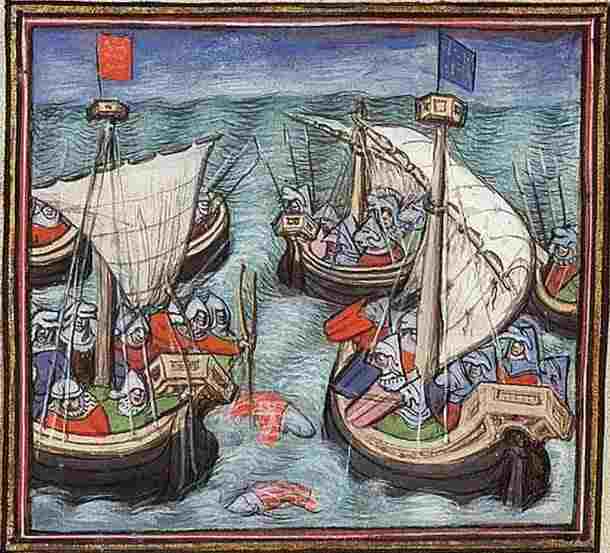
The Battle of Arnemuiden was fought off the coast of what is now the Netherlands on 23 September 1338. It was the first naval battle of the Hundred Years War and is notable for the early use of gunpowder artillery at sea in Europe.
Edward III’s urgent need to export to Flanders
In 1338 Edward III’s plans on the continent rested upon his ability to finance the support of his allies. He had already taken out loans from nobles, bankers and pawned royal jewels, including the great crown, for this purpose. To complete his financing of an allied force, he intended to utilise the value of English Wool.
Merchants across Europe valued English wool very highly. Edward could simply use consignments of the highest grades of wool in lieu of money, something that his allies were willing to accept.
Armed flotilla embarks for Flanders
The problem was that the wool was in England, and it was needed, urgently, in Flanders. 5 of the largest and most powerful Cogs [ships] available to the English were loaded with wool. They were armed vessels, with one, the Christopher, having three cannons and at least one handgun, in addition to the usual archers and infantry to repel assailants.
The squadron of cogs was to transfer their cargo of wool to Antwerp, where the King could then use it to finance campaigning. The French, however, had a new Admiral, Nicholas Béhuchet, along with Hugues Quiéret, who had been tasked, as an admiral, with planning the invasion of England.
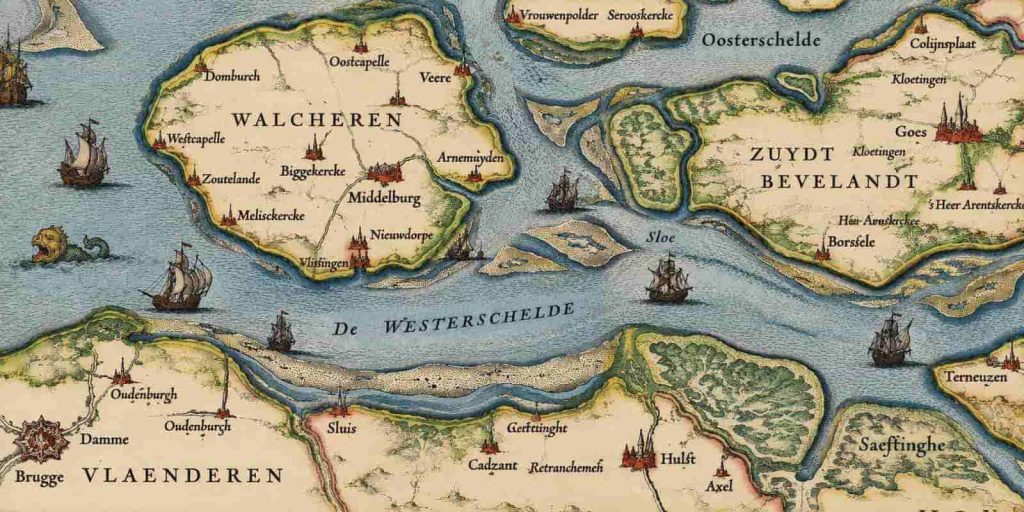
Sea Battle at Arnemuiden, off the port of the island of Walcheren
The reformed French fleet was more aggressive in its approach than had happened previously. The French fleet of over 40 galleys spotted the English cogs and engaged them. Despite the superiority in numbers, the French were tackling five very powerful vessels. The battle continued all day, with heavy losses on both sides.
A translation of Collection des Chroniques Nationales Françaises describes the outcomes:
“Thus conquering did these said mariners of the king of France in this winter take great pillage, and especially they conquered the handsome great nef called the Christophe, all charged with the goods and wool that the English were sending to Flanders, which nef had cost the English king much to build: but its crew were lost to these Normans, and were put to death”.
The fate of the captured English crews was particularly grim. Contemporary and later accounts record that the prisoners were put to death after the battle. The massacre was subsequently associated with Nicolas Béhuchet, who was hanged by the English after his capture at the Battle of Sluys in 1340.
The loss of the five English ships and their valuable cargo was a serious blow to Edward III’s financial and strategic position in the Low Countries. Arnemuiden also marked the beginning of a major phase of naval warfare in the conflict, which would continue through the French coastal raids and culminate in the much larger Battle of Sluys in 1340.
A note on the French Fleet
The size of the French Fleet is variously described as being 48 or 43 Galleys. There are also narratives which indicate that the fleet itself was a combination of French and Castillian Galleys.
Further Reading
Jean-Claude Castex, Dictionnaire des batailles navales franco-anglaises (Presses de l’Université Laval, 2004).