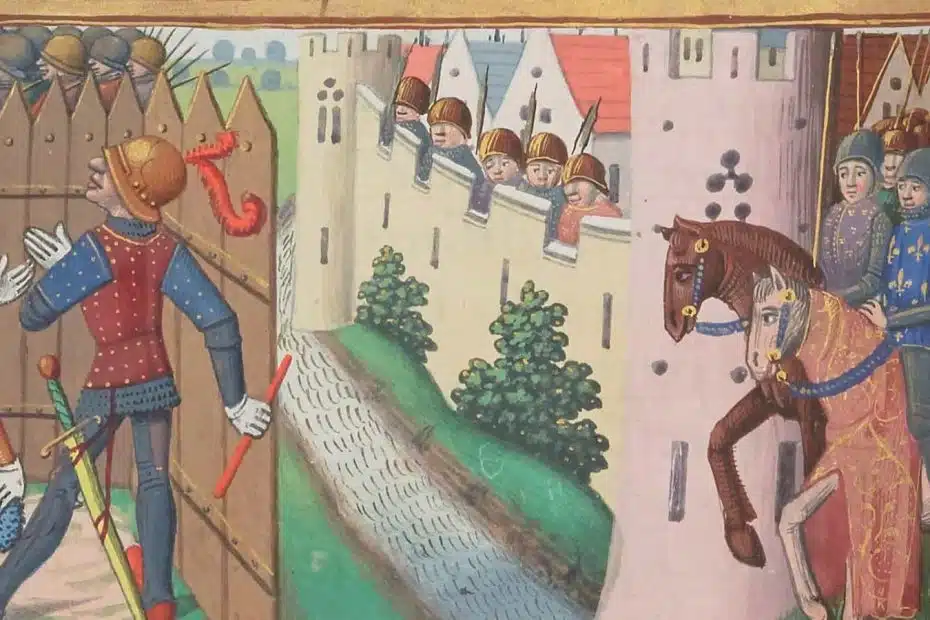
The Siege of Calais was fought from 9 to 29 July 1436, when a large Burgundian and Flemish army besieged the English-held town of Calais during the later stages of the Hundred Years War. The siege followed the breakdown of the Anglo-Burgundian alliance and was directed by Philip the Good, Duke of Burgundy. The English garrison, commanded by Edmund Beaufort, Earl of Mortain, resisted the attack. The failure of the Burgundian naval blockade, the capture of a major Burgundian bastille and the withdrawal of the Flemish contingents forced the besiegers to abandon the siege before an English relief army arrived.
The Break with Burgundy
Calais had been an English possession since its capture by Edward III in 1347 and was strategically important because it connected England with its remaining territories in northern France and provided access to the continental wool trade. The town was defended by a permanent garrison and by the wider system of fortifications and settlements known as the Calais Pale. Its importance also reflected the wider English strategy of securing and maintaining English ports on the Continent, which provided bases for military operations, shipping and trade.
For much of the early fifteenth century England and Burgundy had been aligned against France. That relationship deteriorated after the death of John the Fearless and the subsequent Anglo-French negotiations. Philip the Good increasingly distanced himself from the English government and concluded the Treaty of Arras with Charles VII in 1435.
The Burgundian attack on Calais in 1436 was therefore not simply another French operation against an English possession. It represented the military consequences of the collapse of the Anglo-Burgundian alliance.
For the wider history of the town and its importance to England, see the Calais page on The Wars of the Roses site.
The English Garrison
The English commander at Calais was Edmund Beaufort, Earl of Mortain. He had been appointed captain of Calais and was responsible for maintaining the town’s defences while the Burgundians assembled outside it.
Beaufort had a substantial advantage in the nature of the defence. Calais was strongly fortified, possessed a permanent garrison and could be supplied from the sea. The Burgundian army therefore had to prevent reinforcement and resupply as well as overcome the walls themselves.
The English garrison also included experienced soldiers who understood the defensive requirements of the town. Contemporary English accounts emphasise the resistance offered by the garrison and the difficulties faced by the besiegers.
The later career of Edmund Beaufort made the defence of Calais an important episode in his military career.
The Burgundian Army
Philip the Good assembled a large force drawn from Burgundy, Flanders and other territories under his authority. The army included substantial numbers of Flemish urban militia, Burgundian troops and artillery.
The size of the Burgundian force is uncertain. Contemporary chronicles give very large figures, but these should not be treated as precise totals. The army was nevertheless sufficiently large to surround Calais and establish a series of fortified positions around the town.
The Burgundians also attempted to prevent English assistance reaching Calais by sea. Philip’s forces therefore combined a land siege with a naval operation intended to close the harbour.
The Siege of Calais
The siege began on 9 July 1436. Burgundian and Flemish forces established themselves around Calais and constructed fortified positions from which artillery could be brought against the town. The siege forms part of the wider sequence of battles and sieges of the Hundred Years War.
The English garrison resisted the attacks while attempting to disrupt the besiegers’ operations. The defensive strength of Calais meant that the Burgundians needed to maintain the siege for an extended period if they were to force a capitulation.
The Burgundians hoped that their numerical superiority and control of the surrounding countryside would eventually make the English position untenable. Instead, several elements of the siege began to work against them.
The Failure of the Naval Blockade
One of the most important weaknesses in the Burgundian operation was the failure to seal the harbour effectively.
The Burgundians attempted to obstruct access to Calais by sinking ships loaded with stone. The effort did not successfully prevent English shipping from reaching the town. As a result, the garrison retained access to maritime supplies and the besiegers were unable to isolate Calais completely.
The failure of the blockade was particularly important because a prolonged siege depended upon starving the garrison and preventing reinforcement. Calais’s position on the Channel made control of the sea essential to any successful investment of the town.
English Sorties
The English did not remain entirely behind the walls. Garrison troops made sorties against the Burgundian positions, disrupting the siege works and attacking the besiegers.
These operations were especially important because the Burgundian army had constructed fortified camps and artillery positions outside the town. The English needed to prevent these works from being completed and to maintain pressure on the besiegers.
The continuing resistance also affected the morale of the Flemish contingents, many of whom had been recruited from towns whose governments had committed themselves to the campaign.
The Burgundian Bastille
The Burgundians constructed a major fortified position, or bastille, as part of their siege works. Such temporary fortifications were designed to protect artillery and troops while maintaining pressure on the walls.
The English eventually attacked and captured the position. Its destruction was a major setback because the bastille represented one of the principal elements of the Burgundian investment of Calais.
The capture of the bastille demonstrated that the besiegers could not establish secure positions close enough to the town to guarantee a successful assault.
The Flemish Withdrawal
The siege began to unravel as the Flemish contingents became increasingly unwilling to continue the campaign.
The Flemish militia had expected a relatively rapid victory. The failure to capture Calais, combined with English sorties and the failure of the naval blockade, made the continued siege increasingly difficult to sustain.
As Flemish participation declined, Philip the Good’s ability to maintain the large army around Calais was reduced. The approaching English relief army added a further threat.
Henry VI and the English Relief Army
The English government began preparations for a relief expedition while the siege was underway. The response initially involved an unusual possibility: Henry VI himself considered leading the expedition to Calais.
In a letter of 16 June 1436, Henry stated that he intended, “with God’s mercy”, to go personally to the rescue of Calais. The proposal demonstrates the importance attached to the town by the young king and his government.
The plan for Henry to lead the expedition did not ultimately proceed. Humphrey, Duke of Gloucester, who was captain of Calais, assumed command. On 27 July he was appointed the king’s lieutenant-general, and preparations were made to cross to Calais with a substantial army.
Henry himself travelled to Sandwich to see the fleet depart. Thousands of soldiers and a large fleet were assembled for the expedition.
The first English troops reached Calais on 2 or 3 August. By then, however, the Burgundians had already raised the siege.
The relief expedition therefore did not have to fight a pitched battle to save Calais. The English garrison had survived the siege, while the capture of the Burgundian bastille, the failure of the naval blockade and the withdrawal of the Flemish contingents had forced Philip the Good to withdraw.
Gloucester subsequently took his army into Flanders and Artois, conducting a destructive campaign before returning to Calais.
The End of the Siege
The Burgundians abandoned the siege on 29 July 1436. The operation had failed to capture the town or force the English garrison to surrender.
The English therefore retained Calais, while Philip the Good’s attempt to remove the English from their principal continental bridgehead had ended without success.
The outcome also demonstrated the difficulty of conducting a major siege against a well-defended coastal fortress without secure control of the sea. Calais could continue to receive support by water, while the English garrison could make sorties against the besiegers.
The Political Consequences
The defence of Calais involved the young Henry VI as well as two prominent military figures in the royal government, Edmund Beaufort and Humphrey, Duke of Gloucester.
Henry’s willingness to contemplate leading the relief expedition demonstrates the importance attached to Calais by the Crown. The eventual appointment of Gloucester reflected his position as captain of Calais and one of the principal military figures available to the English government.
For Beaufort, the defence formed part of a military career during the later stages of the Hundred Years War. He was subsequently created Duke of Somerset in 1448.
For Gloucester, the relief expedition formed part of his wider military and political career. His role in the defence and relief of Calais is examined in the substantial biography of Humphrey, Duke of Gloucester on Schoolshistory.
Significance of the Siege of Calais
The Siege of Calais in 1436 failed to remove the English from their most important remaining possession in northern France. The town remained in English hands for another century.
The siege also demonstrated the importance of the Calais garrison within English military strategy. Calais was not simply a fortified town: it was a permanent military base, a commercial centre and a staging point for English operations on the Continent.
The failure of the Burgundian siege was therefore significant beyond the immediate outcome. The combination of strong fortifications, an experienced garrison and access to the sea made Calais difficult to capture.

Sources and Evidence
The evidence for the Siege of Calais comes from several contemporary and near-contemporary traditions. English chronicles provide important accounts of the siege, the defence of the town and the English preparations for relief. Burgundian and Flemish chronicles provide evidence from the opposing side, although their accounts often differ in their descriptions of numbers and events.
Contemporary correspondence is particularly valuable for reconstructing the English response. Letters concerning the mobilisation of troops and ships reveal the urgency with which the government responded to the siege and provide evidence for Henry VI’s proposed personal participation in the relief expedition.
Modern scholarship is used alongside these sources to assess the chronology, military organisation and wider significance of the siege. David Grummitt’s study is particularly important because it devotes a substantial section of The Calais Garrison specifically to the Burgundian siege of 1436.
Sources
| Source | Origin and character | Evidence for the Siege of Calais |
|---|---|---|
| Brut, Continuations H/I and related continuations — View source | Contemporary English chronicle tradition | Provides detailed evidence for the siege, the Burgundian bastille, the English defence and the arrival of the relief expedition. It is one of the most important English narrative sources for the episode. |
| Enguerrand de Monstrelet, Chronique de France — View source | Near-contemporary Burgundian chronicle | Provides evidence from the Burgundian side concerning the siege, the forces involved, the naval blockade, the failure of the operation and the withdrawal. |
| Jean de Wavrin, Recueil des croniques et anchiennes istories de la Grant Bretaigne — View source | Near-contemporary Burgundian chronicle | Provides a detailed account of the campaign and the Burgundian and English military operations around Calais. |
| Chronicle of London, Harley MS 565 — View source | Contemporary English civic chronicle | Records the dates of the siege, the construction and capture of the Burgundian bastille and the eventual withdrawal of the besiegers. |
| Philip the Good, correspondence concerning the siege, 1436 — View source | Contemporary Burgundian correspondence | Provides administrative and political evidence for the Burgundian campaign and its organisation. |
| Jan van Dixmude, Dits de chronike — View source | Flemish chronicle tradition | Provides evidence from the Flemish side of the campaign, particularly concerning the participation and withdrawal of Flemish forces. The transmission and authorship of the surviving text require caution. |
Further Reading
- James A. Doig, “A New Source for the Siege of Calais in 1436”, English Historical Review, 1995.
- James A. Doig, “Propaganda, Public Opinion and the Siege of Calais in 1436”, 1995.
- Marie-Rose Thielemans, “Une lettre missive inédite de Philippe le Bon concernant le siège de Calais”, Bulletin de la Commission royale d’Histoire, 1950.
- David Grummitt, The Calais Garrison: War and Military Service in England, 1436–1558, Boydell Press, 2008, especially chapter 2, “The Burgundian Siege of 1436”, pp. 20–43.
Featured Image
Siege of Calais, 1436. Les Vigiles de Charles VII, manuscrit de Martial d’Auvergne, vers 1484, BnF, Manuscrit Français 5054, enluminure du folio 90 (verso). Source.