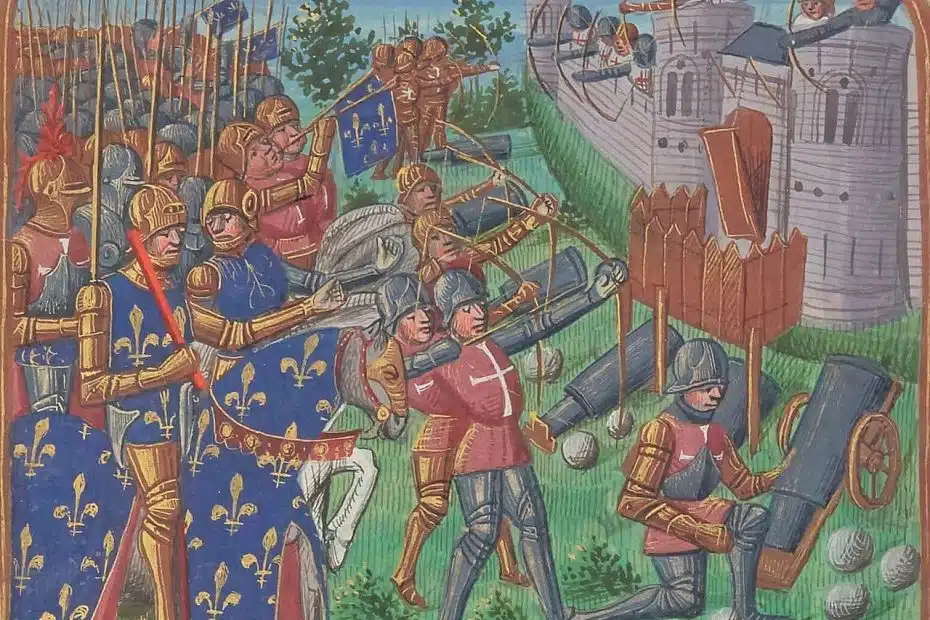
The Siege of Cherbourg was fought from 12 July to 12 August 1450 during the French reconquest of Normandy in the final phase of the Hundred Years War. French forces under Arthur de Richemont, Constable of France, besieged the strongly fortified English port for a month, employing mines, trenches and an extensive artillery bombardment. The English garrison under Thomas Gonville eventually capitulated on 12 August. Cherbourg was the last English stronghold in Normandy, and its fall brought English rule in the duchy to an end.
The siege followed the English defeat at the Battle of Formigny on 15 April 1450. The destruction of the principal English field army left the remaining garrisons isolated. Charles VII was therefore able to concentrate French forces against Cherbourg, whose formidable defences made it the most difficult remaining English position to capture.
The Siege of Cherbourg, 1450
The Last English Stronghold
By July 1450 the English position in Normandy had almost completely collapsed. French forces had recovered much of the duchy during the campaign that began in 1449, while the English garrisons were increasingly isolated from one another.
The defeat at Formigny had been particularly important. Sir Thomas Kyriell’s army had been sent to reinforce the English position in Normandy, but its defeat removed the principal field force available to oppose the French. The remaining English-held towns and castles therefore had to defend themselves without the prospect of effective military relief.
Cherbourg was the strongest of those remaining positions. Situated at the northern end of the Cotentin peninsula, it was protected by substantial fortifications and by the sea. At high tide, the sea made the position particularly difficult to approach.
Juliet Barker notes that the castle possessed “quadruple concentric defences”: the curtain wall and towers, a large moat, a second set of walls surrounding the town and castle, and the sea itself. The fortress was consequently capable of resisting a major attack even after the wider English position in Normandy had collapsed.
The English Garrison
The governor of Cherbourg was Thomas Gonville, identified in Monstrelet’s account as Thomas Gouvel. The chronicler states that he had approximately a thousand fighting men under his command.
The garrison was therefore large enough to offer substantial resistance. Its difficulty was not simply the strength of the French army outside the walls, but the fact that no English field army remained capable of forcing the besiegers to withdraw.
The English government had attempted to maintain its remaining positions in Normandy with men, weapons and supplies, but the wider military situation made the defence increasingly difficult. The French controlled the surrounding territory and could concentrate resources against the isolated fortress.
The French Army
The siege was conducted under Arthur de Richemont, Constable of France. He commanded a substantial force of French and Breton troops, supported by an artillery train capable of maintaining a prolonged bombardment.
The French artillery organisation had developed considerably during the reign of Charles VII. Jean and Gaspard Bureau were central to this development, and their work enabled the French monarchy to deploy large quantities of artillery during both field campaigns and sieges.
Cherbourg provided an especially striking demonstration of this capability. The French did not rely upon a single assault. Instead, artillery was combined with trenches, mines and other siege works to maintain continuous pressure against the fortifications.
The Bombardment
Enguerrand de Monstrelet provides the fullest contemporary narrative of the siege. He records that the French attacked with “mines and batteries” and that the walls were subjected to an exceptionally heavy bombardment from both land and sea.
The most remarkable feature was the positioning of heavy bombards on the shore. The guns were placed where they could fire when the tide was out, but were covered when the tide returned. Monstrelet explains that the artillerymen protected the guns and their powder with greased skins so that the seawater would not damage them.
When the tide receded, the coverings were removed and the guns resumed firing. Monstrelet describes this as being “to the great astonishment of the English, who had never seen such an invention.”
The bombardment was dangerous even for the besiegers. Monstrelet records that four bombards and one cannon burst while firing against the walls. Nevertheless, the French were able to continue the bombardment and maintain pressure upon the garrison.
Mines and Siege Works
Artillery was only one part of the French operation. Monstrelet specifically mentions the mines and batteries employed against Cherbourg. The besiegers therefore combined gunpowder artillery with established methods of medieval siege warfare.
Trenches provided protected approaches towards the fortifications, while mining offered a means of weakening defensive structures. The combination of these techniques allowed the French to maintain pressure without relying upon a direct assault against the strongest parts of the defences.
The siege illustrates the transitional nature of late medieval warfare. Gunpowder artillery was becoming increasingly important, but it had not replaced older methods of siegecraft. Cherbourg was reduced through the combined use of artillery, engineering and sustained investment.

French Losses
The English defence remained effective enough to inflict serious casualties. Among the French dead was Prigent de Coëtivy, Admiral of France and Seigneur de Retz.
Monstrelet records that Coëtivy was killed by a cannon shot and describes his death as a major loss to the French king. Tuddual le Bourgeois, Bailiff of Troyes, was also killed by a shot from a culverin.
The death of Coëtivy demonstrates that the French artillery advantage did not make the siege a risk-free operation. The defenders continued to use their own weapons effectively and could inflict losses on senior French commanders.
A later fifteenth-century manuscript, the Vigiles du roi Charles VII, also depicts the siege and specifically identifies the death of Coëtivy by a culverin. The manuscript was produced in 1484, so it is later evidence rather than an eyewitness account, but it preserves a near-contemporary visual representation of the event.
Why Was Cherbourg Not Relieved?
The central weakness of the English position was the absence of a field army capable of breaking the siege. The defeat at Formigny had removed the principal English force in Normandy, while the remaining garrisons were themselves under pressure.
Cherbourg’s fortifications could delay the French, but they could not remove the army surrounding the town. The French, by contrast, controlled the surrounding territory and could maintain their forces, artillery and supplies while continuing the siege.
The problem was therefore strategic rather than simply defensive. The English could continue resisting behind their walls, but there was no realistic prospect of restoring the wider military situation in Normandy.
The Surrender of Cherbourg
After the prolonged bombardment and other siege operations, Thomas Gonville sought terms from Richemont. Monstrelet records that the English governor “demand[ed] a capitulation from the constable, which he obtained.”
The surviving act of capitulation records the surrender of the town, castle and donjon of Cherbourg on 12 August 1450. The agreement established the terms under which the English garrison would leave.
Monstrelet states that Gonville surrendered the town and castle on condition that his son, who was being held as a hostage in connection with money owed to the king of France and the inhabitants of Rouen, would be released. Once this condition had been fulfilled, the English garrison departed with its arms and baggage.
The French therefore did not need to storm Cherbourg. The combination of artillery, mines, trenches and the complete isolation of the garrison had made continued resistance impossible to sustain.
The Fall of Normandy
The surrender of Cherbourg completed the French reconquest of Normandy. Monstrelet described the achievement as the recovery of the whole duchy, stating that its towns and castles had been brought under French obedience in “one year and six days”.
The speed of the reconquest was remarkable. French forces had combined field operations, siege warfare and negotiated surrender to recover the duchy from the English. The fall of Cherbourg was the final stage of that process.
The significance of the surrender was immediately recognised in England. James Gresham wrote to John Paston shortly afterwards:
“Shirburgh is goon, and we have not now a foote of londe in Normandie.”
The statement captured the strategic significance of the surrender. Cherbourg was the final English stronghold in Normandy, and its loss brought the Lancastrian occupation of the duchy to an end.
The Political Consequences
The loss of Normandy intensified criticism of Henry VI and his government. Military failure had already damaged confidence in the Lancastrian administration, and the complete loss of Normandy provided further grounds for criticism.
Edmund Beaufort, Duke of Somerset, who had held senior military responsibilities in France and Normandy, became one of the figures associated with criticism of the military failures.
The loss of France also formed part of the wider political crisis of 1450. The Cade Revolt was driven by a range of grievances concerning royal government, taxation, corruption and the conduct of officials. The loss of Normandy contributed to the atmosphere of dissatisfaction, but was one element within a much wider political crisis.
The Significance of Cherbourg
The Siege of Cherbourg illustrates the changing military balance during the final phase of the Hundred Years War. The English still possessed powerful fortifications and a garrison capable of resisting a major French army for several weeks. The French, however, had developed the organisation, artillery and resources necessary to maintain a sustained siege.
Monstrelet’s account is particularly revealing. His description of bombards operating from the tidal shore demonstrates the practical use of gunpowder artillery in a major siege. At the same time, the continued use of mines and trenches shows that artillery had not replaced traditional siege methods.
The fall of Cherbourg was therefore not simply the capture of a fortress. It was the final military consequence of the destruction of the English field army at Formigny and the subsequent French recovery of the remaining Norman strongholds.
The Hundred Years War continued after the fall of Cherbourg. England retained Calais and possessions in Gascony, and the conflict continued until the French victory at Castillon in 1453. But English rule in Normandy had ended permanently.
Sources and Evidence
The sources for the Siege of Cherbourg are unusually valuable because they combine a detailed contemporary narrative with documentary evidence for the surrender and contemporary English correspondence reporting its consequences.
Enguerrand de Monstrelet provides the fullest narrative account. His description covers the French command, the English garrison, the mines and batteries, the extraordinary use of bombards on the tidal shore, the deaths of Prigent de Coëtivy and Tuddual le Bourgeois, and the negotiations that resulted in the surrender.
The Chronique du Mont-Saint-Michel provides an important independent record of the campaign and specifically identifies the surviving act of capitulation between Arthur de Richemont and Thomas Gower, together with its subsequent ratification by Charles VII. The Paston correspondence provides contemporary English evidence for the significance of the fall.
The Vigiles du roi Charles VII provides later visual evidence. Its depiction of the siege dates from 1484 and therefore cannot be treated as eyewitness evidence, but the manuscript is sufficiently close to the events to be useful when considered alongside the written sources.
| Source | Origin and character | Evidence for the Siege of Cherbourg |
|---|---|---|
| Enguerrand de Monstrelet, Chronique de France — View source | Near-contemporary French chronicle | The principal narrative account of the siege. Describes Richemont’s command, the English garrison under Thomas Gonville, mines and batteries, the bombardment from land and sea, the shore-mounted bombards, the deaths of Prigent de Coëtivy and Tuddual le Bourgeois, and the negotiations leading to the surrender. |
| Chronique du Mont-Saint-Michel — View source | Contemporary Norman chronicle tradition | Records the French recovery of Cherbourg and provides evidence for the date of the surrender. Its documentary material identifies the surviving capitulation of 12 August 1450 and its ratification by Charles VII. |
| Capitulation of Cherbourg, 12 August 1450 — View source | Contemporary administrative and legal record | Records the formal surrender of the town, castle and donjon of Cherbourg and the terms under which the English garrison was permitted to leave. |
| Charles VII, ratification of the capitulation of Cherbourg, August 1450 — View source | Contemporary royal act | Confirms the agreement by which Cherbourg passed into French royal possession. |
| James Gresham to John Paston, August 1450 — View source | Contemporary English correspondence | Reports the fall of Cherbourg and its immediate significance for England, including the statement that the English no longer possessed “a foote of londe in Normandie”. |
| Vigiles du roi Charles VII, BnF Français 5054, fol. 206 — View source | Fifteenth-century illustrated chronicle, produced in 1484 | Depicts the Siege of Cherbourg and the death of Prigent de Coëtivy by a culverin. It is later than the siege and should therefore be treated as visual evidence rather than an eyewitness account. |
Further Reading
- Anne Curry, Guns and Goddams: Was there a Military Revolution in Lancastrian Normandy 1415–50?, Journal of Medieval Military History, Vol. VIII, 2010, pp. 171–188.
- Anne Curry, Concilier les ambitions militaires et les intérêts civils: l’occupation anglaise de la Normandie (1417–1450), Revue du Nord, No. 402, 2013, pp. 967–976.
- Anne Curry, Les soldats anglais en garnison en Normandie 1417–1450, Bulletin de la Société des Antiquaires de Normandie, Vol. 74, 2017.