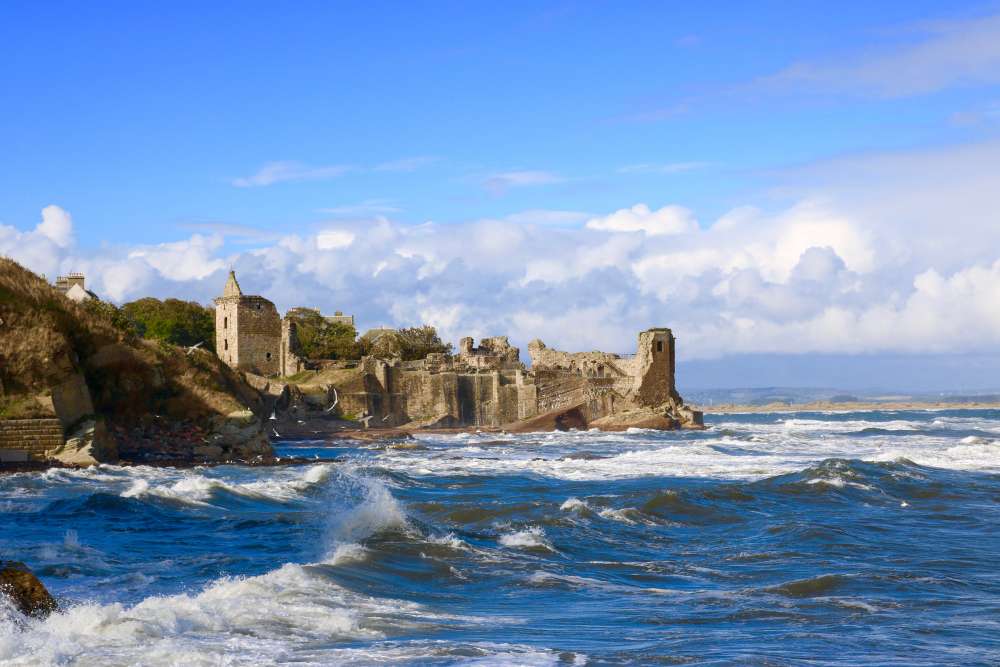
On 28 February 1337 St. Andrew’s Castle surrendered to the Scots. It had been seized by English forces in June of 1336 as part of a lightening campaign designed to limit Scottish capabilities as England went to war on the continent.
Limiting the risk of Scotland
The political and diplomatic problems faced by Edward III in 1337 were not limited to the sovereignty of Aquitaine. So too, did he face problems to the north, in Scotland. The Auld Alliance of France and the Scots often worked in tandem against the English, forcing a conflict on two fronts on the English King. This was the case in 1336/7.
Scorched Earth
Edward was faced with the prospect of having to send a relief force to Bordeaux, was planning an alliance to fight in the Low Countries and had an ongoing conflict with armies in the field in Scotland. Three campaigns, plus defending the English coastline, would be a huge burden for the treasury to bear. So, in 1337, the English set about limiting Scotland’s ability to cause damage in the north. A ‘Scorched Earth’ type campaign was launched by Edward up the East coast, with a second front opening in the western lowlands to finish off the task.
Withdrawal and gradual surrender of English garrisons
That series of campaigns had begun in June 1336. To tie up Scottish resources, garrisons were left at several Castles in Scotland. St. Andrew’s Castle was one of these. As the English withdrew the bulk of their force, the Scots gradually set about the task of removing the unwanted English garrisons. On 28 February 1338, the Garrison at St. Andrew’s surrendered.
St. Andrew’s Castle Surrenders
It is described in the delineations of Dr. Grierson.
“THE CASTLE. This fortress was founded towards the conclusion of the twelfth century, it is said in the year 1200, by Roger, one of the bishops of St Andrews, and son of Robert, the third Earl of Leicester after the Conquest. It stood on a point of land projecting towards the sea on the north side of the town. It was enlarged and repaired betwixt the years 1318 and 1328, by Bishop Lamberton of this place, who fixed his residence in it. But in 1336, Edward III, king of England, having subdued and laid under contribution the greater part of the Scottish kingdom, placed a garrison in the castle to command the town and neighbouring country. On his retreat into England, however, which happened a few months after, Andrew Murray of Bothwell, in conjunction with the Earls of March and Fife, besieged this stronghold with battering machines and reduced it in the space of three weeks. It surrendered on the 28th of February 1337, and they entirely demolished it a short time after. It remained for many years in a ruinous state, for Bishop Landels resided in the abbey and died there”. Dr Grierson’s delineations
Featured Image
Ruins of St. Andrew’s Castle. By Matthew Leonard. This file is licensed under the Creative Commons Attribution-Share Alike 4.0 International license. Via Wikimedia.
